
 AePS
AePS Micro ATM
 Money Transfer
 Banking Services
 Payment Solutions
 Mobile Recharge
 Utility Bill Payment
 DTH Recharge
 Cash and EMI Collection
 IRCTC Booking
 Bus Ticket Agent
 Courier Service Point
 Health Insurance
 Hospicash Insurance
 Bike Insurance
 Car Insurance
 PAN Card Agent
 Digital Gold Seller
 Gift Card
 Solar Installation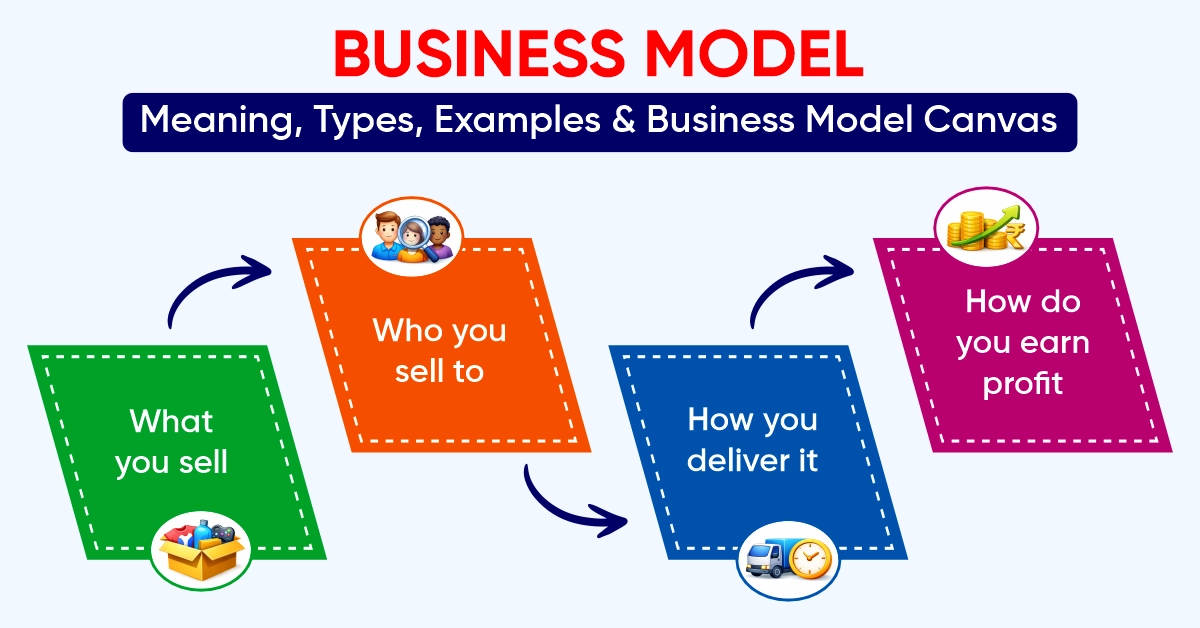
Every successful company, whether it is a small shop or a billion-dollar startup, runs on one strong foundation: a business model.
Many people start a business with a product idea, but fail because they do not clearly understand how they will earn money. That is where a business model becomes important.
In simple words, a business model explains:
- What you sell
- Who you sell to
- How you deliver it
- How do you earn profit
Whether it is an e-commerce business model, a SaaS business model, a franchise business model, or a subscription business model, everything depends on how the company creates and captures value.
In this detailed guide, you will learn:
- What is a business model
- Business model meaning & definition
- Types of business models
- Business model canvas template
- Business model canvas examples
- Digital and new business models
- Business model innovation
- Business model analysis
Let’s start from the basics.
What is a Business Model?
Business Model Simple Definition
A business model is a plan that explains how a company creates, delivers, and earns money from its products or services.
Business Model Meaning in Simple Words
If someone asks, “What is a business model?” you can answer: A business model defines how a business works and makes a profit.
It answers three important questions:
- Who is your customer?
- What value are you giving?
- How will you earn revenue?
Difference Between Business Model and Business Plan
Many people confuse these two.
| Business Model | Business Plan |
|---|---|
| Explains how business earns money | Explains how business will operate |
| Focus on revenue and value | Focus on execution strategy |
| Short and strategic | Detailed document |
The business model is the base. The business plan is built on it.
Components of a Business Model
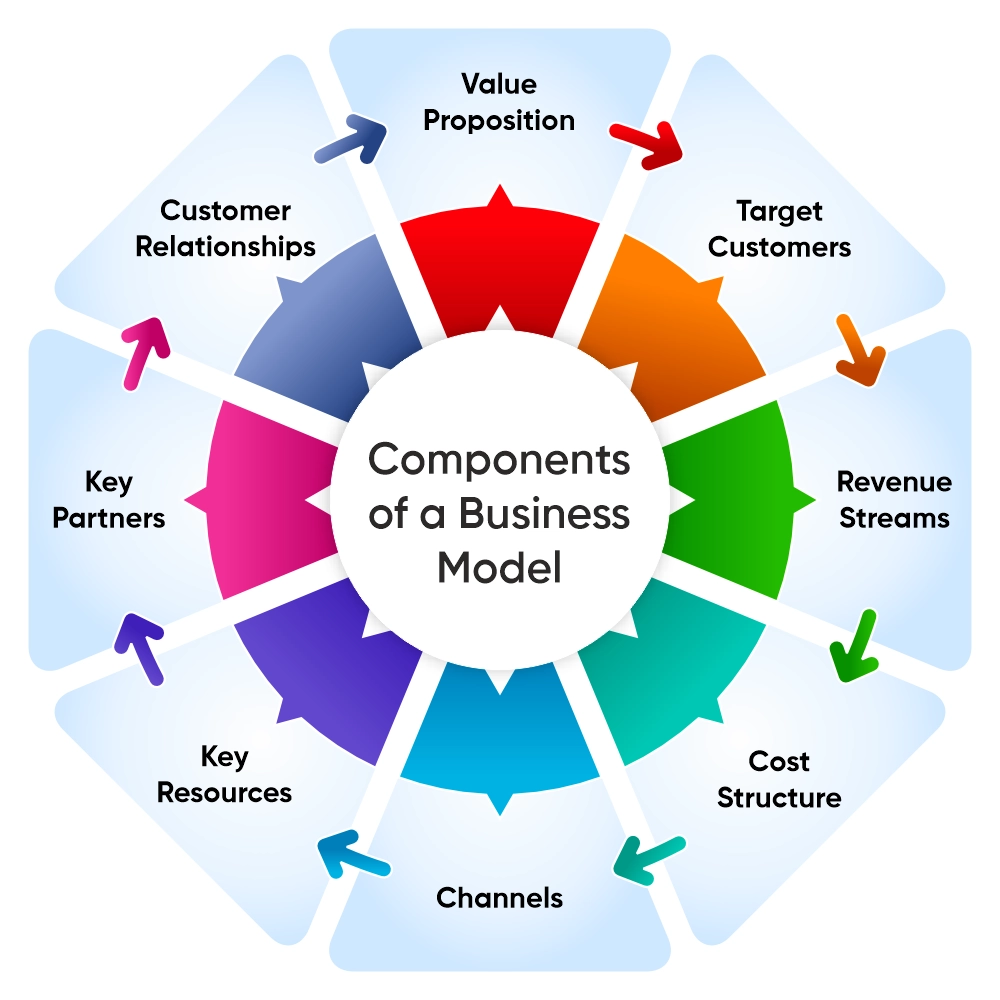
Every strong business model is built on clear components. These building blocks help a company create value and earn profit. Let’s understand each one in detail:
Value Proposition
This is the heart of your business model. It explains what problem you are solving and why customers should choose you over competitors. Your value can be lower price, better quality, faster service, convenience, or innovation. A strong value proposition clearly answers: Why should customers buy from you?
Target Customers
You must define who your ideal customers are. Are they students, working professionals, small businesses, or large companies? Understanding customer age, income, needs, and behavior helps you design the right product and marketing strategy.
Revenue Streams
Revenue streams show how your business earns money. It could be product sales, subscription fees, commission, advertising income, licensing, or service charges. A successful business model may have multiple revenue sources for stability.
Cost Structure
This includes all major expenses such as rent, salaries, marketing, raw materials, technology, and logistics. Controlling costs while maintaining quality ensures higher profit margins.
Channels
Channels are the ways you reach customers. It can be physical stores, websites, mobile apps, social media, distributors, or direct sales teams.
Key Resources
These are essential assets required to operate the business, such as staff, technology, machinery, brand reputation, or intellectual property.
Key Partners
Partners may include suppliers, distributors, investors, or technology providers who help in smooth business operations.
Customer Relationships
Building long-term relationships through support, loyalty programs, and quality service ensures repeat business and trust.
Understanding these components helps in building a strong and profitable business model.
What is Business Model Canvas?
The business model canvas is a visual tool used to design and understand a business model clearly.
It was created by Alexander Osterwalder and is used worldwide by startups and companies.
If someone asks, “What is business model canvas?” the answer is: Business model canvas is a one-page framework that shows how a business creates, delivers, and captures value.
It has 9 building blocks:
- Customer Segments
- Value Proposition
- Channels
- Customer Relationships
- Revenue Streams
- Key Resources
- Key Activities
- Key Partners
- Cost Structure
This makes business planning simple and structured.
Business Model Canvas Template
A business model canvas template is usually divided into 9 boxes.
Startups use it because:
- It is easy to understand
- It shows the full business picture
- It helps in business model analysis
- It reduces confusion
How to Fill Business Model Canvas Step-by-Step
- Define your customer segment
- Write your value proposition
- Decide revenue model
- Identify cost structure
- Add partners and resources
- Finalize delivery channels
It is one of the best tools for new entrepreneurs.
Business Model Canvas Examples
Let us understand with real examples.
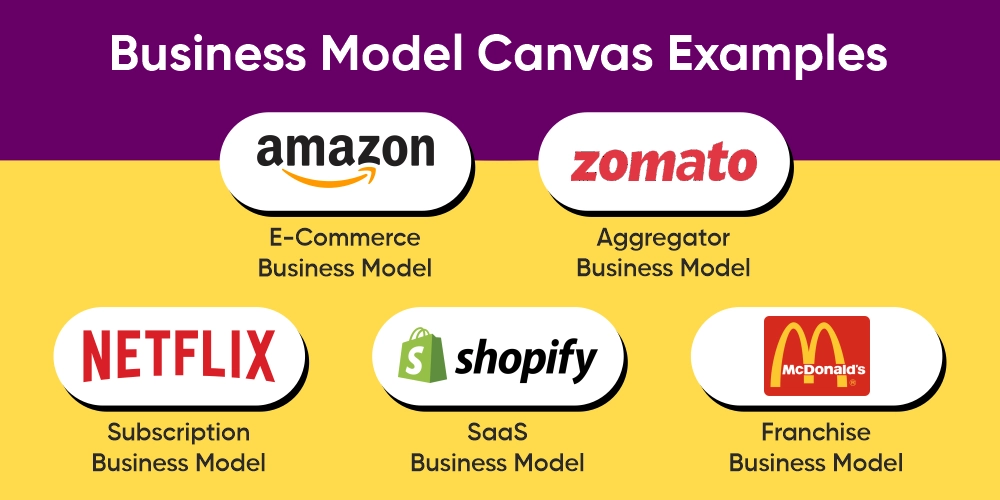
Amazon – E-Commerce Business Model
Amazon follows a marketplace-based e-commerce business model.
- Connects sellers and buyers
- Earns commission
- Also sells its own inventory
Netflix – Subscription Business Model
Netflix uses a subscription-based business model.
- Monthly or yearly payment
- Unlimited content access
- Recurring revenue
Zomato – Aggregator Business Model
Zomato follows an aggregator business model.
- Connects restaurants and customers
- Earns commission per order
McDonald’s – Franchise Business Model
McDonald’s uses a franchise business model.
- Brand licensing
- Franchise fee
- Royalty income
Shopify – SaaS Business Model
Shopify follows a SaaS business model.
- Monthly subscription
- Cloud-based software
These are powerful business model examples used globally.
Types of Business Models
There are many types of business models, and each works differently based on customers, revenue method, and operations. Below are the most popular and practical models used in India and globally.
B2B Business Model (Business to Business)
- In the B2B business model, a company sells products or services to other businesses.
- The customer is not an individual, but another company.
- Orders are usually bulk and long-term.
- Profit margins may be lower per unit but higher in volume.
Examples:
- Software companies selling ERP to factories
- Wholesale suppliers selling goods to retailers
This model focuses on relationships, contracts, and repeat business.
B2C Business Model (Business to Customer)
- In the B2C business model, companies sell directly to end customers.
- Products are marketed through ads, offers, and branding.
- The buying decision is emotional and quick.
Examples:
- Retail stores
- Online shopping websites
It requires strong marketing and customer experience.
E-Commerce Business Models
These models operate online using websites or mobile apps.
Main types include:
- Inventory-based model – Business keeps stock and sells online.
- Marketplace model – Platform connects buyers and sellers.
- Dropshipping business model – No inventory is stored by the seller.
E-commerce business models are growing rapidly in India.
Dropshipping Business Model
- Seller does not maintain inventory.
- Supplier ships the product directly to the customer.
- Low investment required.
- Suitable for beginners.
However, profit margins can be low due to high competition.
SaaS Business Model (Software as a Service)
- Customers pay subscription fees for cloud-based software.
- Revenue is recurring.
- No physical product involved.
Examples:
- Accounting software
- CRM software
It offers scalability and predictable income.
Subscription Business Model
- Customers pay monthly or yearly fees.
- Business earns steady recurring revenue.
- Common in OTT, gyms, and online learning platforms.
This model ensures predictable cash flow.
Freemium Business Model
- Basic services are free.
- Advanced features require payment.
- Helps in attracting large users first.
Used by many mobile apps and digital platforms.
Aggregator Business Model
- The platform connects service providers with customers.
- Business earns commission on each transaction.
Examples include food delivery and cab booking apps.
Cloud Kitchen Business Model
- Delivery-only restaurant.
- No dining space required.
- Lower rental and staff cost.
- High demand in urban areas.
Franchise Business Model
- Brand gives business rights to franchise owner.
- Franchisee pays initial fee and royalty.
- Lower risk than starting from zero.
- Proven system and brand support available.
Also Read: Best Franchise Business Opportunities in India 2026
Choosing the right business model depends on your investment, market demand, and long-term goals.
Digital Business Models
Today, digital business models are growing very fast due to internet usage, smartphones, and online payments. These models operate mainly through websites, apps, or cloud platforms.
Online Education Platforms
These platforms provide courses through websites or mobile apps. They earn through subscription fees or course purchases.
Example: An online learning app charging ₹999 for a digital marketing course.
OTT (Over-The-Top) Platforms
OTT platforms stream movies and web series online. They follow a subscription-based business model or advertising model.
Example: A streaming app charging a monthly membership for unlimited content access.
App-Based Services
Mobile apps provide services like food delivery, cab booking, or grocery shopping. They earn commission on each transaction.
Example: A food delivery app earning 20% commission per order.
AI-Based Services
AI businesses offer automation tools, chatbots, or data analysis software. They usually follow a SaaS subscription model.
Digital transformation has created scalable and low-cost business opportunities in India.
Business Model Innovation
Business model innovation means changing how a company earns money.
Example: Netflix started with DVD rental. Later, it moved to streaming.
That shift made it successful globally.
Business model innovation helps companies:
- Stay competitive
- Reduce costs
- Increase revenue
- Enter new markets
In India, many startups use innovative models to disrupt traditional markets.
Business Model Analysis in Simple & Practical Guide
Before starting or scaling any business, doing a proper business model analysis is very important. It helps you understand whether your idea is profitable and sustainable in the long run.
Here are the key points to check:
Revenue Sustainability
Ask yourself: Is your income stable and recurring?
A strong business model should not depend on one-time sales only. Models like subscription or repeat customers provide a steady income. Stable revenue ensures business survival during slow periods.
Profit Margin
Are you earning enough after deducting all expenses?
Calculate gross profit and net profit clearly. Even if sales are high, low margins can create financial problems. Healthy profit margins support growth and reinvestment.
Cost Efficiency
Are your costs under control?
Review fixed costs (rent, salaries) and variable costs (marketing, raw materials). A good business model keeps unnecessary expenses low while maintaining quality.
Scalability
Can your business grow easily?
Scalable models like SaaS or digital platforms can expand without increasing costs proportionally. Scalability increases long-term profit potential.
Competitive Advantage
What makes you different from competitors?
It could be pricing, technology, brand value, or service quality. Without uniqueness, survival becomes difficult.
A proper business model analysis reduces risk and increases chances of long-term success.
Business Process Modelling
Business process modelling means creating a clear design of how tasks and activities flow within a business. It shows step-by-step how the work is completed, from start to finish.
What is Business Process Modelling?
It is a method of visually mapping business operations. For example, how an order is received, processed, packed, and delivered to the customer.
This helps business owners understand:
- Who is responsible for each task
- How departments are connected
- Where delays or mistakes happen
Why It Is Important
Business process modelling helps in:
- Improving efficiency by removing unnecessary steps
- Reducing errors through clear workflow
- Automating operations using technology
- Saving time and operational costs
It increases productivity and improves customer satisfaction.
Common Business Process Modelling Tools
Some popular tools include:
- Flowcharts – Simple diagram of process steps
- BPMN diagrams – Professional business workflow mapping
- Lucidchart – Online diagram tool
- Microsoft Visio – Advanced process design software
A strong business model always needs well-defined and structured processes for long-term success.
How to Create Your Own Business Model
Creating a strong business model is the first step toward building a profitable and sustainable business. Follow these structured steps:
Identify a Real Problem
Every successful business solves a problem. Start by observing the market and understanding customer pain points. Ask:
- What difficulties are people facing?
- Is there a gap in existing products or services?
- Can you offer a better, faster, or cheaper solution?
A business built on a real need has higher chances of success.
Create a Strong Value Proposition
Your value proposition clearly explains why customers should choose you. Define:
- What solution are you offering?
- How is it different from competitors?
- What benefits will customers receive?
Keep it simple, clear, and focused on customer benefits.
Choose the Right Revenue Model
Decide how you will earn money. Common options include:
- Product sales
- Subscription-based model
- Commission model
- Freemium model
Choose a revenue model that matches your target customers and industry.
Estimate Costs and Resources
Calculate fixed and variable costs such as:
- Marketing expenses
- Rent or office space
- Staff salaries
- Technology or software
Understanding the cost structure helps in pricing correctly.
Start Small and Test
Launch with a minimum investment. Test your idea in a small market to gather feedback and validate demand.
Scale Gradually
Once your model is profitable and stable, expand operations carefully. Increase marketing, improve systems, and grow step-by-step for long-term success.
Common Mistakes in Choosing a Business Model
Choosing the wrong business model can lead to financial losses, slow growth, and even business failure. Below are the most common mistakes entrepreneurs make and how to avoid them.
Copying Competitors Blindly
Many new entrepreneurs simply copy a competitor’s business model without proper research.
- What works for one company may not work for another.
- Different businesses have different customer bases, capital strength, and brand value.
- Market conditions and timing also matter.
Instead of copying, study competitors and then improve or differentiate your model. Always adapt according to your target market and resources.
No Clear Revenue Stream
Some businesses focus only on product development but forget to define how they will earn money.
- Are you charging customers directly?
- Will you earn through commission, subscription, or advertising?
- Is your pricing sustainable?
Without a clear revenue model, cash flow problems arise quickly. A strong business model must clearly define revenue streams from day one.
Ignoring Customer Acquisition Cost (CAC)
Customer Acquisition Cost means how much money you spend to get one customer.
Many startups spend heavily on marketing but fail to calculate:
- Cost of ads
- Sales team expenses
- Promotional discounts
If your CAC is higher than the profit earned from a customer, your business will not survive long-term. Always compare CAC with Customer Lifetime Value (CLV).
High Expenses from the Beginning
Starting with high office rent, large staff, and heavy marketing can create financial pressure.
- Keep fixed costs low in the initial stage.
- Start small and grow gradually.
- Use digital tools instead of large infrastructure.
A lean cost structure increases survival chances.
Depending on One Income Source
Relying only on a single revenue stream is risky.
For example:
- If your only income is advertising and traffic drops, revenue falls immediately.
Diversifying revenue through multiple streams, such as subscriptions, upselling, or partnerships, makes the business more stable.
Future of Business Models in India
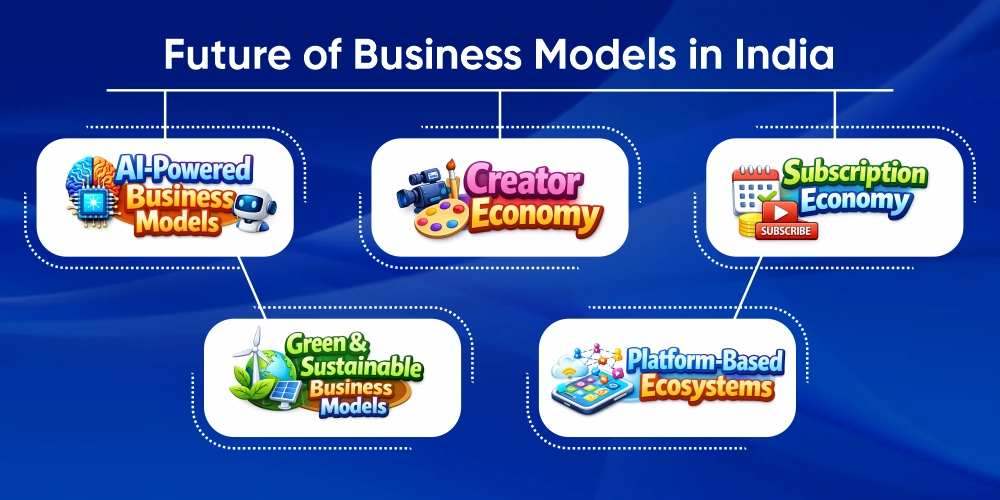
India is rapidly evolving due to digital growth, internet penetration, and startup culture. The future of business models looks highly innovative and technology-driven.
AI-Powered Business Models
Artificial Intelligence is transforming industries.
- AI-based automation reduces costs.
- Chatbots improve customer service.
- Data analytics improves decision-making.
AI-driven platforms will dominate future digital business models.
Creator Economy
Content creators are building personal brands through YouTube, Instagram, and online courses.
Revenue sources include:
- Brand collaborations
- Affiliate marketing
- Paid memberships
This model requires low investment but strong personal branding.
Subscription Economy
Consumers prefer access over ownership.
Examples include:
- OTT platforms
- Online learning platforms
- Software services
Subscription-based business models offer predictable and recurring revenue.
Platform-Based Ecosystems
Platform businesses connect multiple users.
Examples:
- Marketplace apps
- Service aggregator platforms
These models scale quickly because they do not own inventory but control the ecosystem.
Green & Sustainable Business Models
Consumers are becoming environmentally conscious.
Businesses focusing on:
- Renewable energy
- Eco-friendly packaging
- Sustainable products
will gain long-term trust and demand.
India’s growing digital economy, startup ecosystem, and young population are creating massive opportunities for innovative and scalable business models in the coming years.
FAQs on Business Model
What is a business model?
A business model explains how a company creates value, delivers products or services to customers, and earns profit. It defines the target market, revenue sources, and cost structure of a business.
What is business model canvas?
The business model canvas is a one-page visual framework that helps entrepreneurs design and understand their business structure. It includes 9 key elements like value proposition, customer segments, revenue streams, and cost structure.
What are the types of business models?
Common types include:
- B2B (Business to Business)
- B2C (Business to Customer)
- SaaS business model
- Subscription model
- Freemium model
- Franchise model
- Aggregator model
- Dropshipping model
- Cloud kitchen model
What is the SaaS business model?
In the SaaS (Software as a Service) business model, customers pay a monthly or yearly subscription to access cloud-based software.
What is subscription based business model?
Customers pay regularly (monthly or yearly) to access products or services. It ensures recurring and predictable income.
What is an aggregator business model?
It is a platform that connects service providers with customers and earns commission on each transaction.
What is the cloud kitchen business model?
A delivery-only restaurant model with no dining space, reducing rent and operational costs.
What is business model innovation?
It means changing or improving how a company earns money to increase growth and stay competitive.
What is business model analysis?
It is the process of evaluating revenue, costs, scalability, and competitive advantage to ensure long-term profitability.
Conclusion
A strong business model is the backbone of every successful company. It clearly defines how your business creates value, earns revenue, and manages costs.
Without a clear business model:
- Revenue becomes unstable
- Expenses increase unnecessarily
- Growth becomes slow and risky
Whether you choose a B2B, E-commerce, SaaS, or franchise business model, clarity and planning are essential.
Use tools like the business model canvas template, perform regular business model analysis, and focus on solving real customer problems.
The right business model can transform a small idea into a scalable and profitable enterprise.
Also Read: How to Earn 1000 Rs Per Day Without Investment Online in India 2026