
 AePS
AePS UPI Cash Withdrawal
 Micro ATM
 Money Transfer
 Banking Services
 Loan
Loan Credit Card Agent
 Payment Solutions
 Mobile Recharge
 Utility Bill Payment
 DTH Recharge
 Wi-Fi Service Partner
 Cash and EMI Collection
 IRCTC Booking
 Bus Ticket Agent
 Courier Service Point
 health insurance
 Hospicash Insurance
 Bike Insurance
 Car Insurance
 PAN Card Agent
 Digital Gold Seller
 Gift Card
 Solar Installation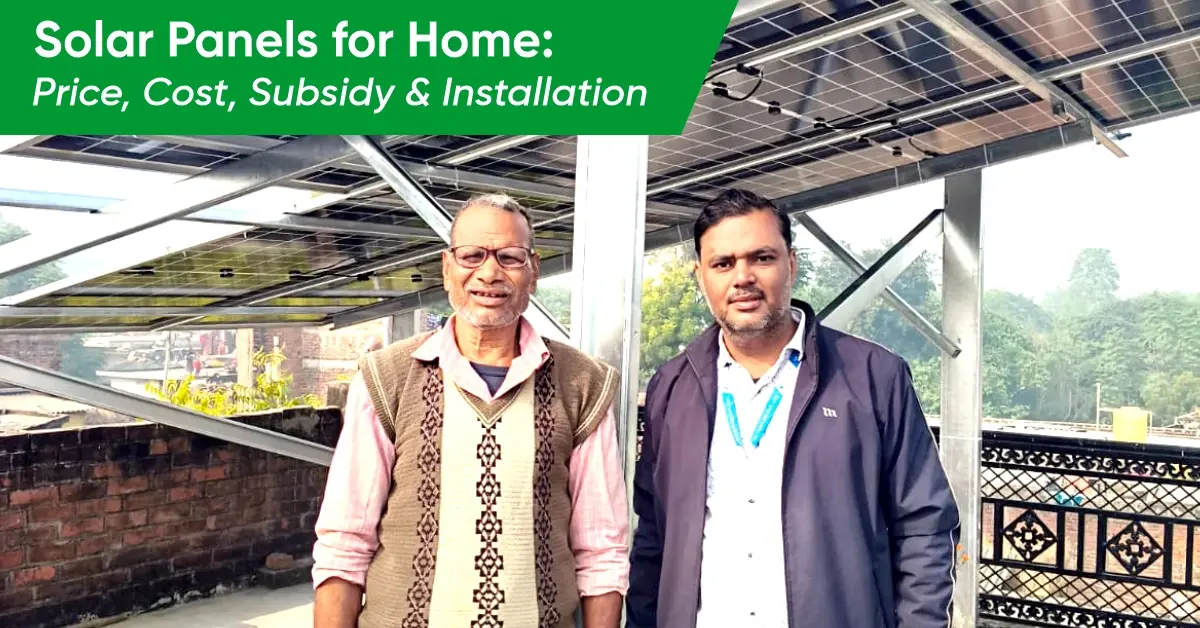
Electricity bills in India are increasing every year. Many families are paying ₹2,000 to ₹6,000 per month just for power. At the same time, power cuts are still common in many areas.
Because of this, solar panels for home are becoming very popular in India.
Today, installing a solar panel system for the home is not just an environmental choice; it is a smart financial decision. With government subsidy and a 25-year lifespan, solar power can save lakhs of rupees in the long term.
In this complete guide, you will learn:
- Solar panel for home price in India
- 1kW & 3kW solar panel price
- Solar panels for home government subsidy
- Solar panel with battery for home
- Best solar panels for home in India
- How much solar panel required for home
- Cost of solar panel installation for home
Let’s start from the basics.
What Are Solar Panels for Home?
Solar panels are devices that convert sunlight into electricity. They are installed on your rooftop and connected to an inverter and your home’s main power system.
When sunlight hits the panels:
- It creates DC electricity
- The inverter converts DC into AC
- AC power runs your fans, lights, fridge, TV, and AC
This complete setup is called a solar panel system for home.
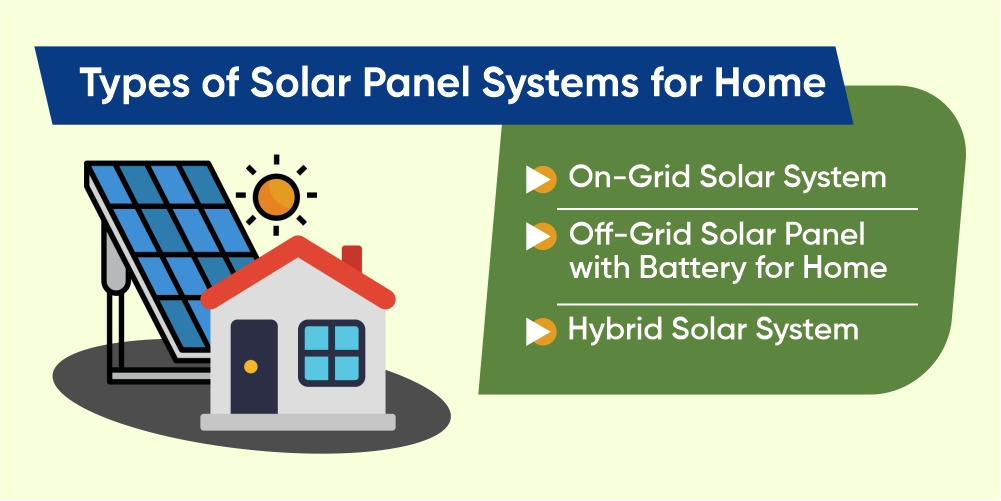
Types of Solar Panel Systems for Home
There are three main types of solar panel systems for homes in India. Your choice depends on budget, electricity availability, and backup needs.
On-Grid Solar System
- Connected to Electricity Grid: This system works along with your local electricity supply (DISCOM).
- No Battery Required: It directly uses solar power during the day and grid power at night.
- Net Meter Benefit: Extra electricity generated during the day is sent back to the grid, reducing your bill.
- Lower Cost: Since no battery is needed, the installation cost is lower.
- Best For: Homes in cities with stable electricity supply and low power cuts.
Also Read: On-Grid Solar Systems for Homes
Off-Grid Solar Panel with Battery for Home
- Independent System: Works without any grid connection.
- Requires Battery: Stores electricity for night use and power cuts.
- Higher Cost: Battery increases total system cost.
- Best For: Villages, farms, or areas with frequent power failures.
Also Read: Off-Grid Solar Systems for Homes
Hybrid Solar System
- Combination of On-Grid + Battery: Connected to the grid but also includes battery backup.
- Power Storage Option: Stores excess power for emergency use.
- Flexible & Reliable: Offers both bill savings and backup support.
- Best For: Homes that need a continuous power supply with occasional power cuts.
Solar Panel for Home Price in India 2026
The most common question is: What is the solar panels for home cost in India?
The price depends on:
- System size (1kW, 3kW, 5kW)
- Type of panels
- Battery included or not
- Installation charges
Below is the average market price in India.
Solar Panel Cost in India for Home (Without Subsidy)
| System Size | Suitable For | Approx Price (Without Subsidy) |
|---|---|---|
| 1kW | 1BHK home | ₹60,000 – ₹85,000 |
| 2kW | Small family | ₹1,00,000 – ₹1,30,000 |
| 3kW | 2–3BHK home | ₹1,50,000 – ₹1,80,000 |
| 5kW | Large home with AC | ₹2,50,000 – ₹3,00,000 |
Solar Panel for Home 1kW Price in India
- Average Price: ₹60,000 – ₹85,000 (without subsidy). With government subsidy, the cost can be reduced to around ₹40,000 – ₹55,000.
- Electricity Generation: Produces approximately 4–5 units per day (120–150 units per month), depending on sunlight conditions.
- Suitable For: 1BHK homes or small families with basic appliances like fans, lights, TV, and refrigerator.
- Rooftop Space Required: Around 80–100 sq. ft. shadow-free area.
- Best Use Case: Ideal for households with monthly electricity consumption up to 150 units.
- Payback Period: Around 3–4 years, depending on electricity bill savings.
Solar Panel for Home 3kW Price in India
- Average Price: ₹1.5 lakh – ₹1.8 lakh (before subsidy). After subsidy, it may cost ₹1 lakh – ₹1.3 lakh approx.
- Electricity Generation: Produces 12–15 units per day (360–450 units per month).
- Suitable For: 2–3BHK houses using fridge, washing machine, cooler, and 1–2 ACs.
- Rooftop Space Required: Around 250–300 sq. ft.
- Best Use Case: Ideal for families with electricity bills between ₹2,500 – ₹4,000 per month.
- Payback Period: Around 3 years with proper sunlight and usage.
Solar Panels for Home Government Subsidy
- Scheme Authority: The rooftop solar subsidy is managed by the Ministry of New and Renewable Energy (MNRE) under the PM Surya Ghar Yojana rooftop solar programme.
- Who Can Apply: Residential homeowners installing rooftop solar panels for their home through approved vendors.
- Subsidy Structure (Approximate):
- Up to 3kW system → 40% subsidy
- 3kW to 10kW system → 20% subsidy (Subsidy is calculated on the benchmark cost set by the government.)
- Example Calculation: If a 3kW solar panel system for home costs ₹1,60,000:
- 40% subsidy = ₹64,000
- Final payable amount ≈ ₹96,000
- How You Receive Subsidy: After installation and inspection, the subsidy amount is directly transferred to your bank account.
- Benefits:
- Reduces solar panel for home price in India significantly
- Shortens payback period to around 3–4 years
- Encourages clean and affordable energy adoption
Government subsidy makes rooftop solar more affordable for middle-class families in India.
How to Apply for Solar Panels for Home Government Scheme
- Visit the Official Portal: Go to the PM Surya Ghar Yojana rooftop solar portal managed by the Ministry of New and Renewable Energy (MNRE). This is the official platform for residential solar subsidy applications. Or you can do the process with SaurSetu, they help you with this process.
- Register Your Details: Enter your mobile number, electricity consumer number, state, and DISCOM details. Verify using OTP.
- Choose an Approved Vendor: Select a government-registered solar installer from the portal list. Only approved vendors are eligible for the subsidy.
- System Installation: The vendor installs the rooftop solar panel system as per the approved capacity.
- Inspection & Net Meter Approval: Your local electricity department inspects the system and installs a net meter.
- Subsidy Credit: After approval, the subsidy amount is directly transferred to your registered bank account.
How Much Solar Panel Required for Home?
This depends on your monthly electricity consumption.
Step 1: Check Your Electricity Bill
Example:
- Monthly consumption = 300 units
- Daily use = 10 units
Step 2: Solar Generation Rule
1kW solar system generates approx 4–5 units per day.
So:
- 1kW → 120–150 units/month
- 2kW → 240–300 units/month
- 3kW → 360–450 units/month
General Solar Installation Recommendation
| House Type | Recommended Solar System |
|---|---|
| 1BHK | 1kW |
| 2BHK | 2–3kW |
| 3BHK | 3–5kW |
| AC + Heavy Load | 5kW+ |
Also, the rooftop space required is approx 100 sq ft per 1kW.
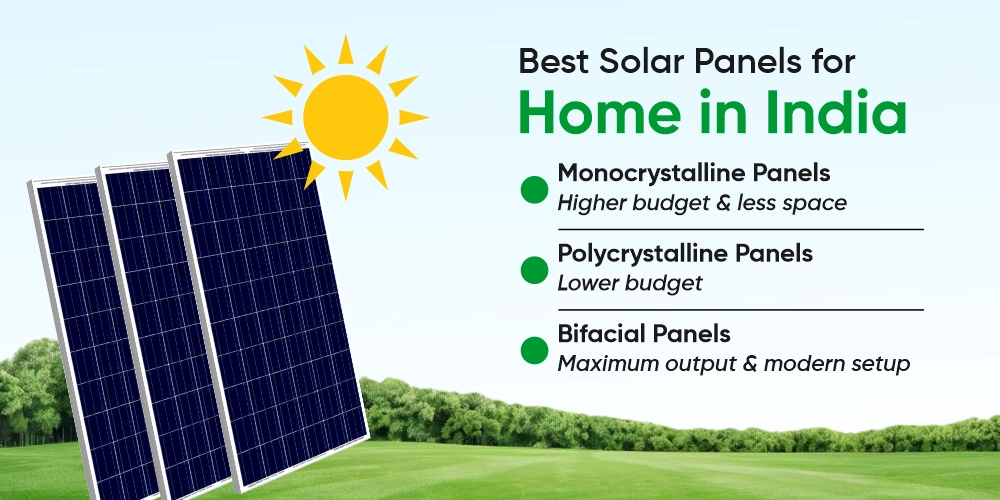
Best Solar Panels for Home in India
Selecting the right solar panels for home is important for maximum savings and long-term performance. Below is a simple comparison:
1. Monocrystalline Panels
- High Efficiency: 18–22%, which means more electricity from less space.
- Better Low-Light Performance: Works well during cloudy weather and winter.
- Long Lifespan: Usually 25 years or more.
- Higher Cost: Slightly more expensive than other types.
- Best For: Homes with limited rooftop space and higher electricity usage.
- Ideal Choice: Considered the best solar panels for home in India for long-term savings.
2. Polycrystalline Panels
- Affordable Price: Lower initial investment.
- Moderate Efficiency: Around 15–17%.
- Good for Large Rooftops: Requires more space to generate the same power.
- Best For: Budget-friendly residential solar installations.
3. Bifacial Panels
- Dual-Side Generation: Produces power from front and back sides.
- High Output: Better performance if installed at height or reflective surface.
- Premium Category: Higher cost but advanced technology.
Which Solar Panel Is Best for the Home?
- Higher budget & less space → Monocrystalline
- Lower budget → Polycrystalline
- Maximum output & modern setup → Bifacial panels
Rooftop Solar Panels for Home – Installation Process
Installing a rooftop solar panel setup for home is a systematic process. It usually takes 7–15 days, depending on approval and site conditions.
- Site Inspection: A technician visits your home to check rooftop size, direction, strength, and available shadow-free space.
- Shadow Analysis: The team checks for shadows from trees, buildings, or water tanks to ensure maximum sunlight exposure.
- Mounting Structure Installation: A strong metal structure is fixed on the rooftop to hold the solar panels safely for 20–25 years.
- Panel Fixing: Solar panels are securely mounted on the structure and aligned properly.
- Inverter Installation: The inverter is installed indoors or near the main power supply area.
- Wiring & Connections: Proper DC and AC wiring is done following safety standards.
- Net Meter Installation: The electricity department installs a net meter for billing adjustment.
- Final Testing & Activation: The system is tested and switched on for power generation.
Cost of Solar Panel Installation for Home
The total solar panels for the home cost includes multiple components. Understanding this helps you plan your budget properly.
- Solar Panels (50–60% of total cost): This is the main expense. Panel price depends on brand, efficiency (mono or poly), and warranty period.
- Solar Inverter (15–20%): Converts DC power into usable AC electricity. Hybrid inverters cost more than on-grid inverters.
- Mounting Structure: Strong metal frames fixed on the rooftop. Cost depends on roof type (flat or slanted).
- Wiring & Accessories: Includes DC cables, AC cables, connectors, an earthing kit, and safety devices.
- Labour & Installation Charges: Professional installation ensures safety and long-term performance.
Usually, all these costs are included in the final package price quoted by the installer.
Solar Panel with Battery for Home
If you want power backup during cuts, a battery is required.
- 1kW Battery Setup: ₹40,000 – ₹70,000
- 3kW Battery Setup: ₹80,000 – ₹1,20,000
Battery increases total cost but provides electricity security and independence from grid failures.
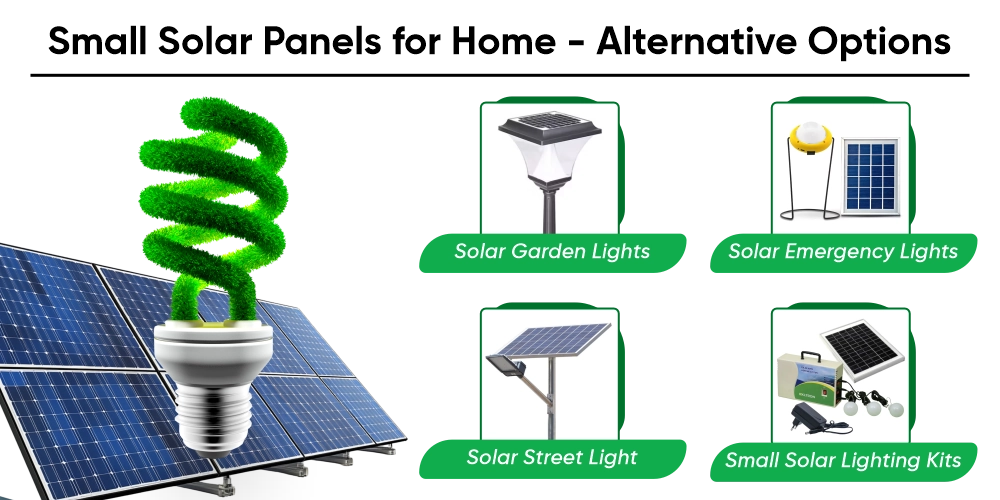
Small Solar Panels for Home – Alternative Options
If you do not want a full rooftop solar panel system for home, you can choose small solar products for limited use.
- Solar Garden Lights: Used for outdoor decoration and security lighting. They charge during the day and automatically turn on at night.
- Solar Emergency Lights: Useful during power cuts. Ideal for indoor lighting in villages and small towns.
- Solar Street Light for Home: Installed outside houses, farms, or parking areas. Provides bright lighting without electricity bills.
- Small Solar Lighting Kits: Includes a small panel, battery, and 2–3 LED bulbs. Suitable for basic lighting needs.
Price Range: ₹1,000 – ₹10,000 depending on capacity and brand.
These products are affordable and useful, but cannot replace a complete rooftop solar system for running heavy appliances.
Solar Panel for Home India – State Wise Demand
Solar power performs best in states with strong sunlight exposure:
- Maharashtra
- Gujarat
- Rajasthan
- Tamil Nadu
- Uttar Pradesh
India receives 4–7 kWh sunlight per sq meter daily, making rooftop solar highly effective across most regions.
Return on Investment (ROI) & Savings Calculation on Solar Installation
Let’s understand financial benefit clearly.
Example:
Monthly electricity bill = ₹3,000
Yearly cost = ₹36,000
3kW solar system cost after subsidy = ₹1,00,000 approx.
Payback period: ₹1,00,000 ÷ ₹36,000 = approx 3 years
After 3–4 years, electricity becomes almost free for the next 20+ years.
Total savings in 20 years: ₹36,000 × 20 = ₹7,20,000
This makes solar panels for home a very strong financial investment.
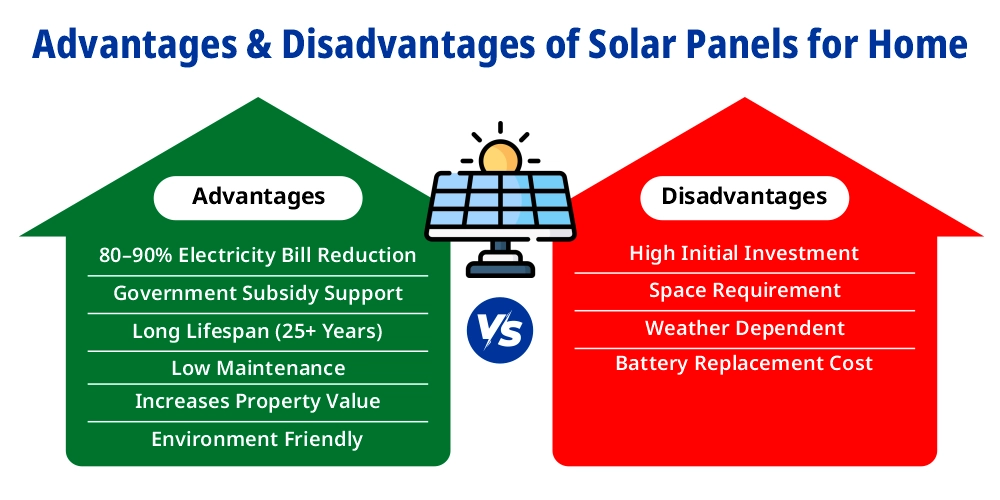
Advantages of Solar Panels for Home
- 80–90% Electricity Bill Reduction: A properly sized solar panel system for home can significantly reduce or even eliminate your monthly electricity bill. Over 20–25 years, this can save lakhs of rupees.
- Government Subsidy Support: The government provides financial assistance through schemes managed by the Ministry of New and Renewable Energy (MNRE), reducing the initial installation cost.
- Long Lifespan (25+ Years): Most solar panels come with a 25-year performance warranty, ensuring long-term energy production.
- Low Maintenance: Only basic cleaning and periodic inspection are required. Maintenance cost is minimal.
- Increases Property Value: Homes with rooftop solar panels are more attractive to buyers due to lower electricity expenses.
- Environment Friendly: Solar energy reduces carbon emissions and dependence on fossil fuels.
Disadvantages of Solar Panels for Home
- High Initial Investment: Installation costs can be high without subsidy support.
- Space Requirement: Around 100 sq. ft. of rooftop space is needed per 1kW system.
- Weather Dependent: Power generation may be reduced during cloudy or rainy days.
- Battery Replacement Cost: In off-grid systems, batteries may need replacement every 5–7 years, increasing long-term cost.
Frequently Asked Questions (FAQ) – Solar Panels for Home
What is the price of solar panels for home in India?
The cost ranges from ₹60,000 to ₹3,00,000, depending on system size (1kW to 5kW), panel type, and whether a battery is included.
What is 1kW solar panel for home price in India?
It costs around ₹60,000 – ₹85,000 before subsidy. After the government subsidy, the price may be reduced significantly.
What is 3kW solar panel for home price in India?
The average price is ₹1.5 lakh – ₹1.8 lakh before subsidy. After subsidy, it may cost around ₹1 lakh – ₹1.3 lakh.
Is a government subsidy available?
Yes, subsidy is available under schemes managed by the Ministry of New and Renewable Energy (MNRE). Residential users can get up to 40% subsidy (as per current guidelines).
Which solar panel is best for home?
Monocrystalline panels are best for higher efficiency, better low-light performance, and long-term savings.
How many solar panel required for home?
It depends on monthly electricity usage. A 1BHK may need 1kW, while a 3BHK may require 3–5kW.
How many years do solar panels last?
Most panels come with a 25-year performance warranty and can work even longer with proper maintenance.
Do solar panels work during power cuts?
On-grid systems stop during power cuts. To get backup, you need a solar panel with battery for the home or a hybrid system.
What is the payback period for home solar?
Usually 3–5 years, depending on system cost and electricity bill savings.
Is rooftop solar safe for the home?
Yes, if installed by certified professionals with proper wiring and earthing, it is completely safe and reliable.
Final Conclusion
Solar panels for home are not an expense; they are an investment.
With rising electricity prices and available government subsidies, 2026 is one of the best times to install a rooftop solar system in India.
If you are planning to reduce electricity bills, increase property value, and secure long-term savings, solar panel system for home is a smart decision.
Also Read: Solar Rooftop: Schemes, Price, and Online Application Guide