
 AePS
AePS UPI Cash Withdrawal
 Micro ATM
 Money Transfer
 Banking Services
 Loan
Loan Credit Card Agent
 Payment Solutions
 Mobile Recharge
 Utility Bill Payment
 DTH Recharge
 Wi-Fi Service Partner
 Cash and EMI Collection
 IRCTC Booking
 Bus Ticket Agent
 Courier Service Point
 health insurance
 Hospicash Insurance
 Bike Insurance
 Car Insurance
 PAN Card Agent
 Digital Gold Seller
 Gift Card
 Solar Installation
Cash withdrawal is a common banking activity in India. Whether you need cash for daily expenses, business payments, emergencies, or other purposes, you can access money from your bank account through several channels.
The most common option is an ATM, but it is not the only one. Customers can also withdraw cash from a bank branch, use eligible cardless cash withdrawal facilities like UPI Cash withdrawal, or access assisted banking services such as AEPS cash withdrawal. A credit card can also be used to withdraw cash, but this works differently from withdrawing money from a savings account and generally involves additional charges.
One important point is that cash withdrawal limits, withdrawal charges and TDS are three different things. Your bank or debit card may have a daily withdrawal limit, certain transactions may attract charges, and tax rules may apply to large cash withdrawals under specific conditions.
This guide explains cash withdrawal limits, ATM withdrawals, bank-counter withdrawals, charges, TDS, credit card cash withdrawal, AEPS and cardless withdrawal in simple terms.
What Is Cash Withdrawal?
Cash withdrawal means taking money out of your bank account or accessing cash through an eligible financial facility.
For example, if you have ₹50,000 in your savings account and withdraw ₹5,000 from an ATM, the ₹5,000 transaction is a cash withdrawal.
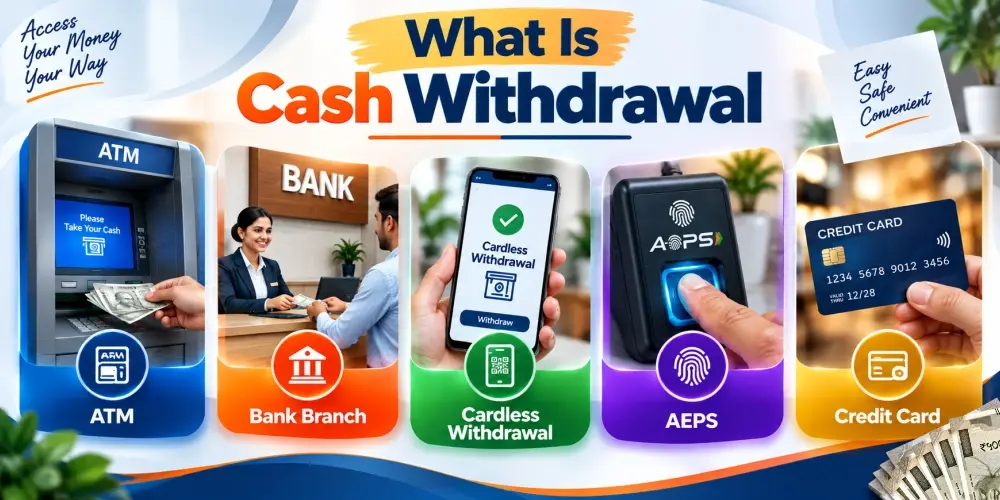
You can generally withdraw cash through:
- ATM: Using an eligible debit card and PIN.
- Bank branch: Using a withdrawal slip, cheque or another permitted method.
- Cardless withdrawal: Using a bank’s eligible UPI mobile/app-based cash withdrawal facility.
- AEPS: Through an authorised banking service point using Aadhaar-based authentication.
- Credit card: Through a cash advance facility, where supported.
The method you choose can affect the withdrawal limit, charges, authentication process and transaction rules.
Cash withdrawal vs cash transfer
These terms should not be confused.
- Cash withdrawal: Money is taken out as physical cash.
- Bank transfer: Money moves electronically from one account to another.
- UPI payment: Money is transferred digitally to a person or merchant.
- Credit card cash advance: Cash is accessed against the available credit facility rather than directly withdrawing your savings balance.
What Is the Cash Withdrawal Limit?
A cash withdrawal limit is the maximum amount you can withdraw through a particular channel during a specified period. There is no single cash withdrawal limit that applies to every bank customer in India.
The applicable limit can depend on:
- Bank
- Account type
- Debit card variant
- ATM transaction rules
- Daily card limit
- Available account balance
- Withdrawal method
- Customer-specific banking conditions
For example, two customers using the same bank may have different ATM withdrawal limits because they have different debit cards.
Cash withdrawal limit per day
The daily cash withdrawal limit is the maximum amount that can generally be withdrawn through the applicable channel during a day. For ATM transactions, this limit is often linked to the debit card.
It is also important to understand the difference between:
Per-transaction limit: Maximum amount that can be withdrawn in one transaction.
Daily limit: Maximum amount that can be withdrawn through the applicable card/channel during the day.
Therefore, if your daily limit is higher than the ATM’s per-transaction limit, you may need more than one transaction to withdraw the desired amount, subject to the bank’s rules and applicable transaction limits.
How Much Cash Can I Withdraw From an ATM?
There is no universal ATM cash withdrawal limit for all banks and cards. The maximum amount you can withdraw depends primarily on your bank and debit-card variant. The ATM itself may also have a per-transaction dispensing limit.
Before making a large withdrawal, check:
- Your debit card’s daily cash withdrawal limit.
- The per-transaction limit.
- Available account balance.
- Applicable ATM transaction charges.
- Whether the ATM has sufficient cash.
For example, having ₹1 lakh in your bank account does not automatically mean that you can withdraw ₹1 lakh from an ATM in one transaction.
Maximum cash withdrawal from ATM
The maximum ATM withdrawal is therefore determined by the lowest applicable restriction.
For example: If your card allows a particular daily amount but the ATM permits a lower amount per transaction, you may have to make multiple transactions, provided you remain within your card’s daily limit and other applicable rules.
This is why customers should check their specific debit-card terms instead of relying on a general ATM withdrawal figure.
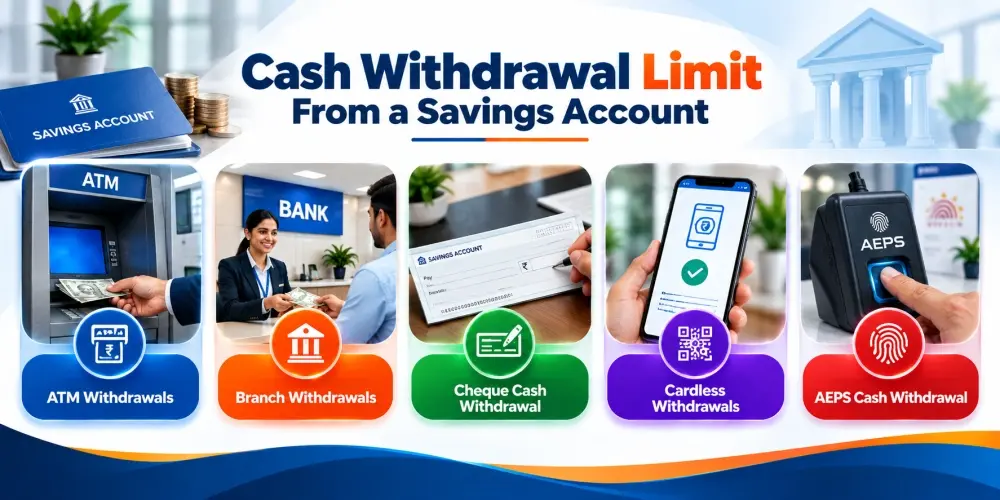
Cash Withdrawal Limit From a Savings Account
A common question is: “Is there a cash withdrawal limit in a savings account?” The answer depends on how and where you are withdrawing the money.
A savings account may have different rules for:
- ATM withdrawals
- Branch withdrawals
- Cash withdrawal using a cheque
- Cardless withdrawals
- Other banking channels
ATM withdrawal from a savings account
When you withdraw cash from an ATM using your debit card, the applicable limit is generally determined by the card and bank.
Cash withdrawal from bank branch
Branch withdrawals may follow different procedures. You may need to complete a withdrawal slip or use another permitted withdrawal method.
Large cash withdrawals
For large cash transactions, customers should also consider applicable banking documentation, PAN requirements and income-tax rules.
Most importantly, having sufficient money in your account does not mean there is no operational withdrawal limit.
Bank-Wise Cash Withdrawal Limits
Bank-specific customer searches such as SBI cash withdrawal limit, ICICI cash withdrawal limit, HDFC cash withdrawal limit and Axis Bank ATM cash withdrawal limit have different search intent.
The exact limit should always be checked against the bank’s latest official information because banks can change limits and conditions.
SBI Cash Withdrawal Limit
SBI customers may have different cash withdrawal limits depending on their debit-card variant and applicable banking rules.
SBI Cash Withdrawal Limit by Method Used
| Withdrawal Method | Cash Withdrawal Limit |
|---|---|
| SBI Debit Card – ATM | Depends on debit-card variant |
| Other Bank Debit Card at SBI ATM | Up to ₹10,000 per transaction |
| SBI Debit Card at Other Bank ATM | Up to ₹10,000 per transaction |
| YONO Cash – ATM | ₹20,000/day; minimum ₹500 |
| YONO Cash – POS | ₹2,000/transaction |
| YONO Cash – CSP | ₹10,000/transaction |
| QR-based Cardless Cash | ₹4,000/day |
| UPI QR Cash / ICCW | Up to ₹10,000/day |
SBI customers should check the applicable limit for their particular debit card rather than assuming that one limit applies to all SBI cards.
YONO cash withdrawal
SBI’s YONO ecosystem also supports eligible digital banking and cardless cash withdrawal facilities.
YONO cash withdrawal can be useful for customers who want to access cash without following the traditional debit-card ATM process.
The applicable eligibility, withdrawal amount, authentication and validity conditions should be checked before using the service.
ICICI Bank Cash Withdrawal Limit
ICICI Bank customers can withdraw cash through ATMs and other eligible channels.
ICICI Cash Withdrawal Limit by Method Used
| Withdrawal Method | Cash Withdrawal Limit |
|---|---|
| Debit Card – ATM | Depends on debit-card variant |
| Coral Debit Card – ATM | ₹1,00,000/day domestic |
| Coral Plus Debit Card – ATM | ₹1,50,000/day domestic |
| Platinum Debit Card – ATM | ₹1,00,000/day domestic |
| RuPay Contactless NCMC Debit Card – ATM | ₹50,000/day |
| Cardless Cash Withdrawal – iMobile/InstaBIZ | ₹20,000/transaction; ₹20,000/day |
| Debit Card – ATM | Depends on debit-card variant |
| Cardless Cash Withdrawal | Depends on the applicable HDFC Bank facility/terms |
| Debit Card – ATM | Depends on debit-card variant |
| Cardless/other digital cash withdrawal | Depends on applicable facility and terms |
The applicable ATM withdrawal limit can depend on the debit-card variant.
ICICI cardless cash withdrawal
Cardless withdrawal facilities allow eligible customers to initiate a withdrawal without physically using their debit card.
Depending on the service, the process may involve: Mobile/app request → Authentication → Eligible ATM → Cash withdrawal. Customers should check the latest ICICI Bank instructions for the applicable process and limits.
HDFC Bank Cash Withdrawal Limit
HDFC Bank customers can withdraw cash through ATMs and eligible branches or digital channels.
HDFC Cash Withdrawal Limit by Method Used
| Withdrawal Method | Cash Withdrawal Limit |
|---|---|
| HDFC Debit Card – ATM | Depends on debit-card variant |
| HDFC Infiniti Debit Card – ATM | ₹2,00,000/day |
| HDFC Platinum / Gold Debit Card – ATM | ₹1,00,000/day |
| HDFC Times Debit Card – ATM | ₹1,00,000/day |
| HDFC Millennia Debit Card – ATM | ₹50,000/day |
| HDFC Rewards Debit Card – ATM | ₹50,000/day |
| HDFC Jet Privilege World Debit Card – ATM | ₹1,00,000/day |
| HDFC Business Debit Card – ATM | ₹1,00,000/day |
| HDFC GIGA Business Debit Card – ATM | ₹1,00,000/day |
| HDFC Woman’s Advantage Debit Card – ATM | ₹25,000/day |
| HDFC MoneyBack Debit Card – ATM | ₹25,000/day |
| HDFC RuPay Platinum Debit Card – ATM | ₹25,000/day |
| HDFC RuPay NRO Debit Card – ATM | ₹1,00,000/day |
| HDFC Debit Card – New account (<6 months) | ₹50,000/day security cap |
| HDFC Debit Card – Account >6 months | Up to ₹2,00,000/day, subject to applicable card/account limit |
| Cash at POS | ₹2,000/transaction; ₹10,000/month/card |
| Cardless Cash Withdrawal | ₹25/transaction charge; withdrawal limit depends on applicable facility |
As with other banks, the ATM withdrawal limit can vary according to the customer’s debit-card type and applicable bank rules.
Cardless cash withdrawal HDFC
Cardless withdrawal can provide an alternative to traditional debit-card withdrawals where the service is available.
Customers should check:
- Eligibility
- Withdrawal limit
- Authentication process
- Transaction validity
- Applicable charges
before using the facility. Also check the limits on HDFC official site.
Axis Bank ATM Cash Withdrawal Limit
Axis Bank customers may have different ATM cash withdrawal limits depending on the debit-card variant and account-related conditions.
Axis Bank Cash Withdrawal Limit by Method Used
| Withdrawal Method | Cash Withdrawal Limit |
|---|---|
| Axis Debit Card – Own Bank ATM | Depends on debit-card/account type |
| Axis Debit Card – Other Bank ATM | ₹10,000/transaction |
| Axis Bank ATM – Daily Limit | Depends on debit-card variant |
| Axis Premium Debit Cards | Depends on specific card variant |
| Axis Cardless Cash Withdrawal | Depends on applicable facility/terms |
| Axis Cash Withdrawal at POS | Subject to applicable card and RBI/POS limits |
Instead of using one generic number, customers should check their specific debit-card terms and the latest information provided by Axis Bank.
Cash Withdrawal Charges
Cash withdrawal charges are fees that may be applied to certain cash transactions.
Charges can depend on:
- Withdrawal channel
- Number of transactions
- Bank
- ATM used
- Debit-card type
- Account type
- Type of transaction
ATM cash withdrawal charges
Banks may provide a specified number of free ATM transactions under applicable rules and account/card terms. Charges may apply when the applicable free transaction allowance is exceeded.
Customers should therefore check their bank’s latest schedule of charges.
Other-bank ATM withdrawals
Using an ATM operated by another bank can also be subject to applicable transaction rules and charges.
The charge depends on the applicable banking framework and the customer’s bank/account conditions.
Important: ATM withdrawal charges are different from cash withdrawal limits.
A limit tells you how much you can withdraw. A charge tells you how much you may have to pay for a particular transaction.
TDS on Cash Withdrawal
TDS on cash withdrawal is a tax-related provision that is often misunderstood. Under Section 194N of the Income-tax Act, TDS can apply to certain cash withdrawals above specified thresholds and subject to the conditions prescribed under tax law. It does not mean that every ATM withdrawal attracts TDS.
The applicability can depend on factors such as:
- Total cash withdrawals during the relevant period
- Taxpayer’s return-filing status
- Applicable threshold
- Conditions prescribed under Section 194N
- Relevant tax rules in force
TDS on cash withdrawal limit
It is important to distinguish between:
ATM cash withdrawal limit: The amount your bank/debit card permits you to withdraw through the ATM.
TDS threshold: A tax-law threshold beyond which TDS may apply under specified conditions.
These are completely different concepts. For example, increasing your ATM limit does not automatically mean that TDS will apply. Similarly, crossing a tax threshold does not mean your ATM card’s daily withdrawal limit automatically changes.
Because tax provisions can be amended, readers should verify the latest Section 194N rules with the Income Tax Department or a qualified tax professional before making significant cash withdrawals.
Cash Withdrawal From Bank Branch
ATM is convenient, but customers can also withdraw money directly from their bank branch.
How to withdraw cash from a bank
The general process is:
- Visit the relevant bank branch.
- Complete the applicable cash withdrawal form/slip or use the permitted withdrawal instrument.
- Enter your account details and withdrawal amount.
- Sign the form as required.
- Submit it at the appropriate counter.
- Complete the bank’s verification process.
- Collect the cash and transaction acknowledgement.
The exact process may differ between banks and account types.
How much cash can we withdraw from a bank?
There is no single universal amount that applies to every bank branch transaction.
The applicable amount can depend on:
- Account type
- Available balance
- Bank policy
- Withdrawal method
- Branch procedures
- Documentation requirements
- Large-cash transaction rules
For significant cash withdrawals, it is sensible to contact the branch beforehand so that you understand the applicable procedure.
What Is a Cash Withdrawal Slip?
A cash withdrawal slip is a form used at a bank branch to request a cash withdrawal from an account.
It generally requires information such as:
- Date
- Account number
- Account holder’s name
- Withdrawal amount
- Amount in words
- Signature
- Other information required by the bank
Example: If you want to withdraw ₹20,000:
Amount in figures: ₹20,000 and Amount in words: Twenty Thousand Rupees Only
Always check the details before submitting the slip.
Withdrawal slip vs cheque
A withdrawal slip is specifically designed for a bank-counter cash withdrawal, while a cheque can be used for several types of payments or withdrawals depending on the account and banking rules.
Credit Card Cash Withdrawal
Credit card cash withdrawal is different from withdrawing money from a savings account. When you withdraw cash using an eligible credit card, the transaction is generally treated as a cash advance. You are accessing your credit facility rather than your deposited bank balance.
How credit card cash withdrawal works
The general process is: Credit card → Eligible ATM → PIN/authentication → Cash advance → Fee/interest → Repayment
Credit card cash withdrawals can be expensive because they may involve:
- Cash advance fee
- Interest charges
- GST on applicable charges
- ATM/operator charges in some situations
Interest treatment can also differ from normal retail purchases.
Credit card cash withdrawal charges
Before withdrawing cash from a credit card, check:
- Cash advance fee
- Applicable interest rate
- When interest starts accruing
- GST
- Available cash withdrawal limit
- Any ATM-related charges
HDFC Credit Card Cash Withdrawal Charges
HDFC credit card cash withdrawal charges depend on the specific credit card and the applicable schedule of charges. Customers should check the latest card-specific terms before using the cash advance facility.
SBI Credit Card Cash Withdrawal Charges
SBI Card’s cash withdrawal charges can vary according to the applicable credit card terms.
Check the latest SBI Card schedule of charges for:
- Cash advance fee
- Applicable interest
- Cash withdrawal limit
- Other applicable charges
Axis Bank Credit Card Cash Withdrawal Charges
Axis Bank credit card cash withdrawal charges depend on the particular card and applicable terms. Before making a cash withdrawal, customers should review the current schedule of charges rather than relying on an old fee figure found online.
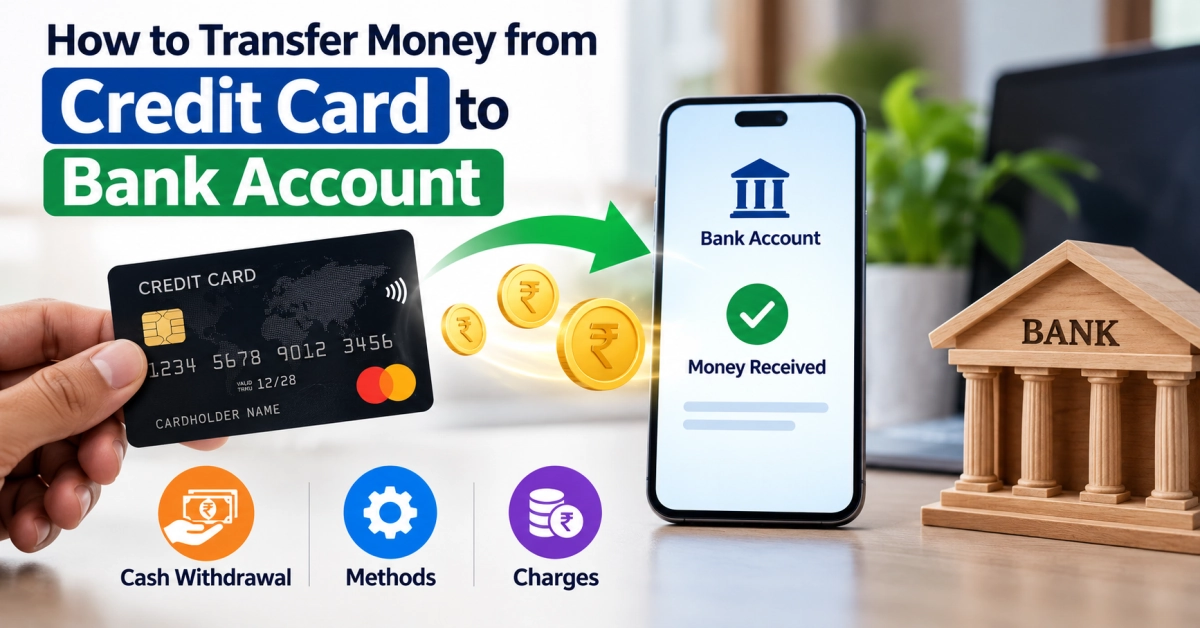
Also Read: How to Transfer Money from Credit Card to Bank Account
Cardless Cash Withdrawal
Cardless cash withdrawal allows eligible customers to withdraw cash without physically inserting or tapping a debit card at an ATM.
Depending on the bank’s system, the customer may initiate the transaction through:
- Mobile banking app or UPI App
- Digital banking platform
- PIN or OTP
- Transaction code
- Other authentication methods
A typical process can look like: Open banking app → Request cash withdrawal → Receive authentication details → Visit eligible ATM → Authenticate → Collect cash
The exact process varies by bank.
Benefits of cardless cash withdrawal
- No need to carry a physical debit card
- Convenient for eligible customers
- Useful when a card is unavailable
- Digital authentication can simplify the process
However, users should never share their OTP, PIN or transaction credentials with anyone.
Also Read: UPI Cash Withdrawal: How to Withdraw Cash Using UPI at ATM Without a Debit Card
AEPS Cash Withdrawal
AEPS (Aadhaar Enabled Payment System) provides a convenient way for customers to withdraw cash through an authorised AEPS service point. With Biznext, customers do not have to pay any charges for AEPS cash withdrawal.
At the same time, AEPS can provide an additional earning opportunity for retailers. Biznext retailers can earn a commission on eligible AEPS cash withdrawal transactions, with the commission based on the transaction value and applicable Biznext terms.
How AEPS Cash Withdrawal Works
- The customer visits a Biznext retailer offering AEPS services.
- The customer provides the required Aadhaar and bank account details.
- The transaction is authenticated using the prescribed Aadhaar-based authentication process.
- Once the transaction is successfully processed, the retailer provides the cash to the customer.
- The retailer receives the applicable commission based on the eligible transaction value.
Benefits for Customers
- No customer charge for AEPS cash withdrawal through Biznext.
- Convenient access to cash through a nearby service point.
- Aadhaar-based authentication.
- Useful where access to an ATM or bank branch may be limited.
Benefits for Retailers
Biznext enables eligible retailers to add AEPS cash withdrawal to their existing services and earn commission on successful transactions based on transaction value. This can help retailers add another financial service to their shop and create an additional earning opportunity.
Want to offer AEPS services from your shop? Retailers can join Biznext as an AEPS service provider and start offering cash withdrawal services to customers, subject to eligibility and applicable terms.
Cash Withdrawal Methods Compared
| Cash Withdrawal Method | Uses Bank Balance? | Physical Card Required? | Main Authentication | Charges |
|---|---|---|---|---|
| ATM Cash Withdrawal | Yes | Usually required | Debit card + PIN | After the applicable free ATM transaction limit (commonly 4 transactions), charges may apply as per the bank’s policy. |
| Cash Withdrawal From Bank Branch | Yes | Not always | Bank verification | Generally free up to the applicable amount/transaction limit; charges may apply after the bank’s specified limit or amount. |
| AEPS Cash Withdrawal | Yes | No | Aadhaar-based authentication | No cash withdrawal charge for the customer through Biznext. Biznext retailers can earn commission based on eligible transaction value. |
| Cardless ATM Cash Withdrawal | Yes | No | Mobile/app + OTP or other authentication | After the applicable free transaction limit (such as 4 transactions), charges may apply depending on the bank’s policy. |
| Credit Card Cash Withdrawal | No – uses credit facility | Credit card required | Credit card + PIN/issuer authentication | Processing/cash advance fee, interest and other applicable charges may apply as per the credit card issuer’s policy. |
Important: The exact number of free ATM/cardless transactions and applicable charges can vary by bank, account type, card and transaction type. Always check the latest schedule of charges of the respective bank.
Cash Withdrawal Limit vs Charges vs TDS
Cash withdrawal limits, charges and TDS are different concepts. Understanding them can help you avoid confusion when withdrawing cash from your bank account.
- Cash Withdrawal Limit: This is the maximum amount you can withdraw through a particular method, such as an ATM, bank branch, cardless ATM or AEPS. The limit may vary by bank, account type, debit card and withdrawal method.
- Cash Withdrawal Charges: Banks may charge a fee after the applicable free transaction limit or specified withdrawal amount. ATM and cardless withdrawals may attract charges after the permitted free transactions. Branch charges depend on the bank’s applicable rules.
- TDS on Cash Withdrawal: TDS may apply to certain high-value cash withdrawals when the conditions and thresholds prescribed under income-tax law are met. It is separate from your ATM or bank withdrawal limit.
In simple terms:
- Limit = How much you can withdraw
- Charges = What fee may apply
- TDS = Tax that may be deducted under applicable rules
How to Withdraw Cash Safely
Whether you use an ATM, bank branch or AEPS service, basic precautions can protect your money and banking information.
Follow these safety practices:
- Never share your ATM PIN.
- Never share OTPs with another person.
- Do not disclose your banking password.
- Cover the keypad while entering your PIN.
- Avoid taking assistance from unknown people at ATMs.
- Check your SMS or banking app after a transaction.
- Keep transaction receipts when necessary.
- Report unauthorised transactions immediately.
- For AEPS, use authorised banking service points.
- Check the amount carefully before leaving the counter or ATM.
Digital banking has made cash withdrawal more convenient, but customers should remain careful with authentication credentials.
Frequently Asked Questions About Cash Withdrawal
1. What is cash withdrawal?
Cash withdrawal means taking money out of a bank account through an ATM, bank branch, AEPS service point, or another eligible withdrawal facility.
2. What is the daily cash withdrawal limit?
There is no single limit for all banks. The daily ATM limit generally depends on the debit-card variant, account type and bank. For example, ICICI’s Coral Debit Card currently lists a domestic ATM limit of ₹1 lakh per day, while Coral Plus lists ₹1.5 lakh.
3. How much cash can I withdraw from an ATM?
The amount depends on your card’s daily limit, the ATM’s per-transaction restriction and your available account balance. Other-bank ATM withdrawals can also have separate restrictions.
4. How many ATM transactions are free?
The free transaction allowance depends on the bank and account. For example, ICICI allows up to 5 financial transactions per month at ICICI ATMs for savings-account holders; at other-bank ATMs, up to 5 transactions are generally free, with a cap of 3 in specified metro locations. (ICICI Bank)
5. What are ATM cash withdrawal charges after the free limit?
Charges vary by bank. For example, SBI’s revised charges include ₹15 + GST per financial transaction at SBI ATMs beyond the applicable free limit, while HDFC lists ₹23 + applicable taxes beyond the free limit. (State Bank of India)
6. What is the SBI ATM cash withdrawal limit?
SBI’s ATM withdrawal limit varies according to the debit-card variant. Therefore, customers should check their specific card rather than using one generic SBI limit.
7. What is the ICICI Bank cash withdrawal limit?
ICICI’s limit varies by debit-card type. For example, the Coral Debit Card currently has a ₹1 lakh domestic ATM withdrawal limit per day, while Coral Plus lists ₹1.5 lakh. (ICICI Bank)
8. What is the HDFC Bank cash withdrawal limit?
HDFC’s ATM cash withdrawal limit depends on the debit-card variant. Its published card information includes different limits for different cards, so customers should check their specific card’s applicable limit.
9. What is the Axis Bank ATM cash withdrawal limit?
Axis Bank’s ATM cash withdrawal limit varies by debit card and account type. Charges beyond the applicable free monthly limit can also vary; Axis currently lists ₹23 per domestic savings-account cash withdrawal transaction beyond the free limit. (Axis Bank)
10. Is cash withdrawal from a bank branch free?
Branch withdrawals depend on the bank, account type, withdrawal amount and applicable free limits. Some accounts allow specified withdrawals without charges, while charges may apply after the applicable limit.
11. What is a cash withdrawal slip?
A cash withdrawal slip is a bank form used to request cash from an account at a branch. It normally includes the account number, amount, date and account holder’s signature.
12. What is cardless cash withdrawal?
Cardless cash withdrawal allows eligible customers to withdraw cash without physically using a debit card, generally through a bank’s mobile/app-based authentication process.
13. What is AEPS cash withdrawal?
AEPS (Aadhaar Enabled Payment System) allows eligible customers to withdraw cash through an authorised AEPS service point using Aadhaar-based authentication.
14. Does AEPS cash withdrawal have a customer charge through Biznext?
No. Biznext does not charge customers for AEPS cash withdrawal. Eligible Biznext retailers can earn commission on successful AEPS transactions based on the applicable transaction value and Biznext’s terms.
15. Is credit card cash withdrawal the same as ATM withdrawal?
No. Debit-card ATM withdrawal generally uses money from your bank account, while credit-card cash withdrawal is a cash advance against your credit facility and may involve processing/cash-advance fees, interest and other applicable charges.
16. Does TDS apply to every cash withdrawal?
No. TDS on cash withdrawal applies only when the conditions and thresholds prescribed under applicable income-tax provisions are met. It is separate from the bank’s ATM withdrawal limit.
17. What is the difference between withdrawal limit and withdrawal charges?
The withdrawal limit tells you how much you can withdraw. Withdrawal charges are fees that may apply to certain transactions after the applicable free limit or under specific bank conditions.
18. Can ATM withdrawal limits and charges change?
Yes. Banks can revise debit-card limits, free transaction allowances and service charges. Always check the bank’s latest schedule of charges before making a large withdrawal.
Conclusion
Cash withdrawal is a simple banking facility, but the withdrawal limit, transaction charges and applicable rules can vary depending on the bank, account type, debit card and withdrawal method.
- ATM withdrawals: Daily limits depend on your debit-card variant. After the applicable free transaction limit, banks may charge a fee.
- Bank branch withdrawals: Customers can withdraw cash using the permitted process, but charges may apply after the bank’s specified free limit or amount.
- Cardless ATM withdrawals: These provide a convenient way to access cash without a physical debit card, with limits and charges depending on the bank.
- AEPS cash withdrawal: Through Biznext, customers can withdraw cash without paying a withdrawal charge, while eligible retailers can earn commission based on successful transaction value.
- Credit card cash withdrawal: It is generally treated as a cash advance and may involve processing/cash advance fees, interest and other applicable charges.
- TDS: TDS on cash withdrawals is separate from ATM or bank withdrawal limits and applies only when the applicable tax-law conditions are met.
Before making a large cash withdrawal, always check your bank’s latest withdrawal limit, free transaction allowance and applicable charges.
Also Read: Cash withdrawal point