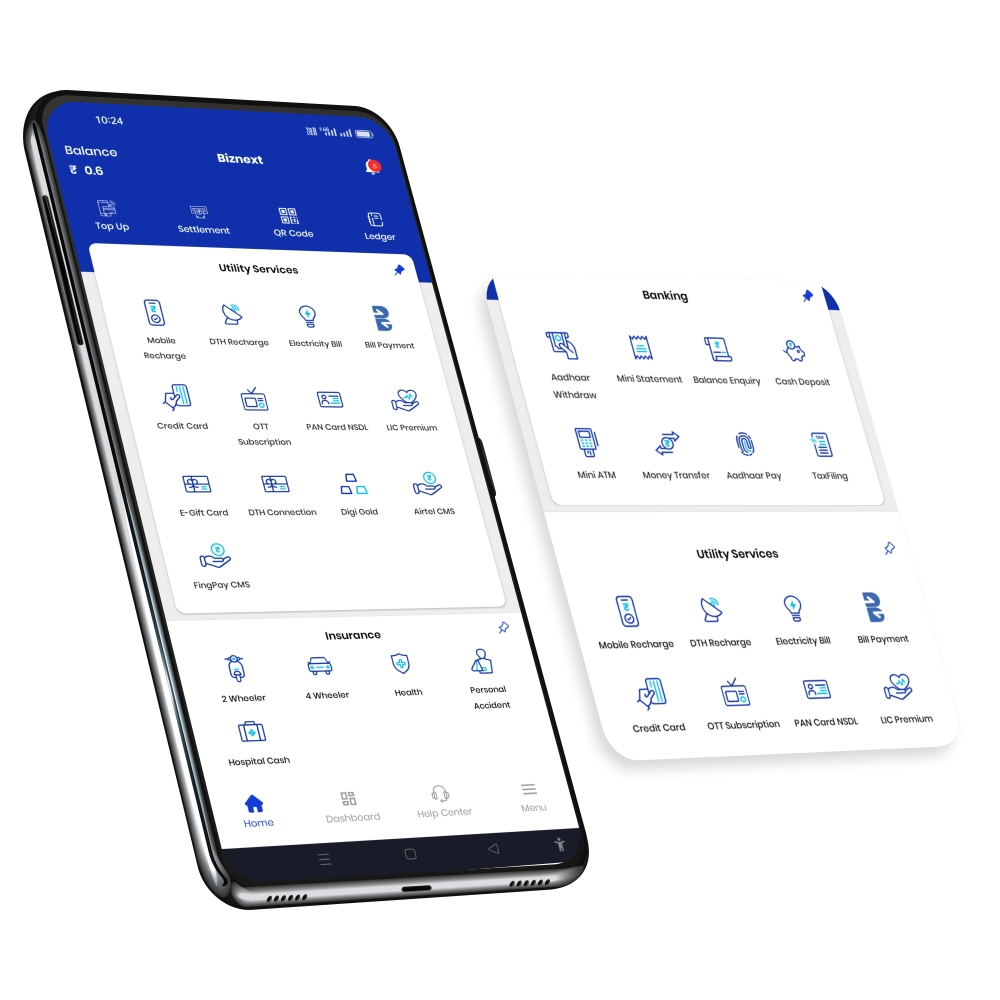

 AePS
AePS UPI Cash Withdrawal
 Micro ATM
 Money Transfer
 Banking Services
 Loan
Loan Credit Card Agent
 Payment Solutions
 Mobile Recharge
 Utility Bill Payment
 DTH Recharge
 Wi-Fi Service Partner
 Cash and EMI Collection
 IRCTC Booking
 Bus Ticket Agent
 Courier Service Point
 health insurance
 Hospicash Insurance
 Bike Insurance
 Car Insurance
 PAN Card Agent
 Digital Gold Seller
 Gift Card
 Solar Installation
Starting a business does not always mean manufacturing your own products or opening a retail shop. Another popular business model is distribution, where you work with manufacturers, brands or service companies and help take their products or services to retailers, dealers and customers.
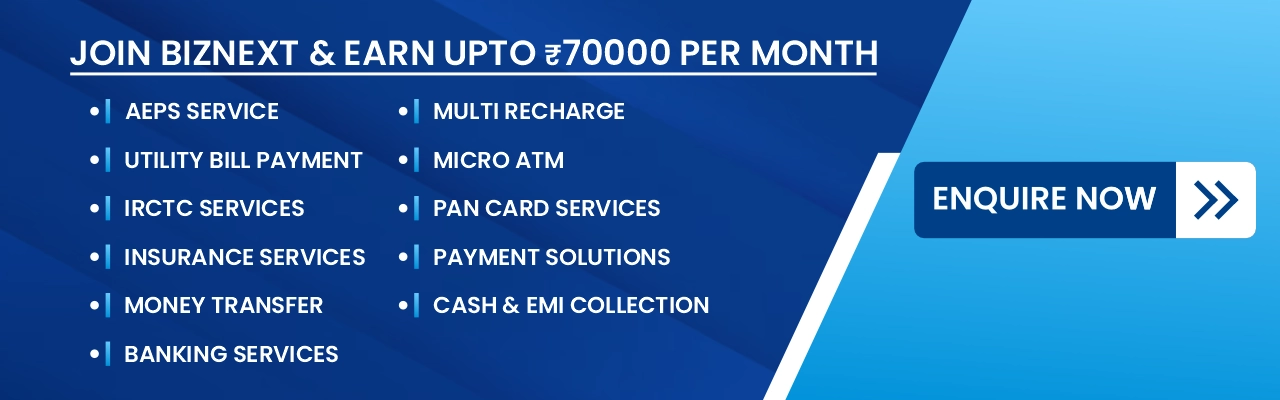
The distributor business can be suitable for people who have good local market knowledge, sales skills, retailer connections and the ability to manage inventory and working capital. Opportunities are available across several categories, including FMCG, electronics, electrical products, agriculture, healthcare, stationery, building materials, automobile products and digital services.
However, taking a distributorship is not simply about finding a company and paying an amount to become its distributor. You need to evaluate the product, market demand, investment, margins, territory, competition, company support and agreement terms before making a decision.
This guide explains what a distributor business is, how distributorship works, how to find companies looking for distributors in India, how to apply for distributorship, investment requirements, FMCG distribution opportunities, local opportunities and the important checks to complete before investing.
What Is a Distributor Business?
A distributor business is a business model in which a person or company purchases or receives products from a manufacturer or brand and supplies them to retailers, dealers, wholesalers or other businesses.
In a traditional distribution chain, products may move through several stages:
Manufacturer → Distributor → Wholesaler/Dealer → Retailer → Customer
However, the exact structure can differ depending on the industry.
For example, an FMCG manufacturer may appoint distributors for different cities or territories. The distributor purchases products according to the company’s commercial terms and supplies them to local retailers. The distributor earns a margin or other agreed commercial benefit from sales.
Distribution can also work differently for services. Some companies appoint business partners or distributors to promote and sell digital or financial services rather than physical products.
Simple Example
Suppose a company manufactures a packaged consumer product and wants to expand into a particular city. Instead of supplying every retailer directly, the company appoints a distributor. The distributor manages local inventory, develops retailer relationships and coordinates product orders.
The company gets access to a wider market, while the distributor gets an opportunity to build a business around product distribution. The actual margin, investment, territory and commercial terms depend on the company and product category.
How Does a Distributor Business Work?
A distributor usually works between the company and the local retail or business network. The basic process can be understood in five steps:
1. Company Manufactures or Provides the Product
A manufacturer produces the goods or a brand sources products for sale. The company then develops a distribution network.
2. Distributor Is Appointed
The company may appoint distributors based on territory, market potential, infrastructure, investment capacity and other eligibility criteria.
3. Distributor Purchases or Receives Inventory
Depending on the business model, the distributor may purchase products from the company and maintain stock.
4. Distributor Supplies the Market
The distributor supplies products to retailers, dealers, wholesalers or institutional customers.
5. Distributor Earns Through the Commercial Model
The distributor may earn through product margins, commissions, incentives or other agreed commercial arrangements.
The business can become more scalable when the distributor develops a strong retailer network and improves repeat orders.
Distributor vs Dealer vs Wholesaler vs Retailer
These terms are often used interchangeably, but they can represent different business roles.
| Business Type | Main Role | Usually Sells To |
|---|---|---|
| Manufacturer | Produces products | Distributors, dealers or customers |
| Distributor | Handles regional/local distribution | Retailers, dealers or wholesalers |
| Wholesaler | Purchases products in bulk and resells them | Retailers/businesses |
| Dealer | Sells products under a company’s commercial arrangement | Customers or retailers |
| Retailer | Sells products to the final customer | End consumers |
The actual responsibilities can vary between industries. Therefore, always read the company’s agreement carefully instead of relying only on the title “distributor” or “dealer.”
Why Start a Distributor Business in India?
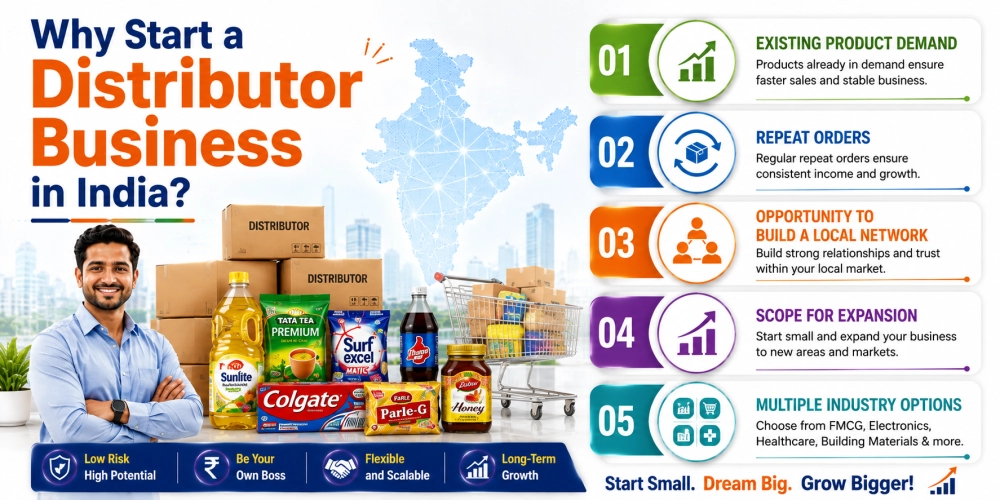
India has a large and diverse consumer and business market. Products need to move from manufacturers to thousands of retailers and businesses across cities, towns and rural markets.
This creates opportunities for distribution businesses. Some important advantages include:
1. Existing Product Demand: If you select a product that already has strong demand, you do not necessarily have to create an entirely new market.
2. Repeat Orders: Many distribution categories involve repeat purchases. FMCG products, office supplies, electrical products and several other categories may require regular replenishment.
3. Opportunity to Build a Local Network: A distributor can develop relationships with retailers and businesses in a specific territory.
4. Scope for Expansion: A successful distributor may expand by:
- Adding more retailers
- Entering new locations
- Adding product categories
- Hiring sales staff
- Increasing inventory
- Working with additional brands where permitted
5. Multiple Industry Options: You are not limited to FMCG. Distribution opportunities can exist in:
- Electronics
- Electrical products
- Agriculture
- Healthcare
- Stationery
- Automobile products
- Building materials
- Consumer goods
- Digital services
However, a distributor business is not a guaranteed-profit business. Product demand, competition, cash flow, operating expenses and company policies can have a major impact on results.
Best Distributor Business Ideas in India
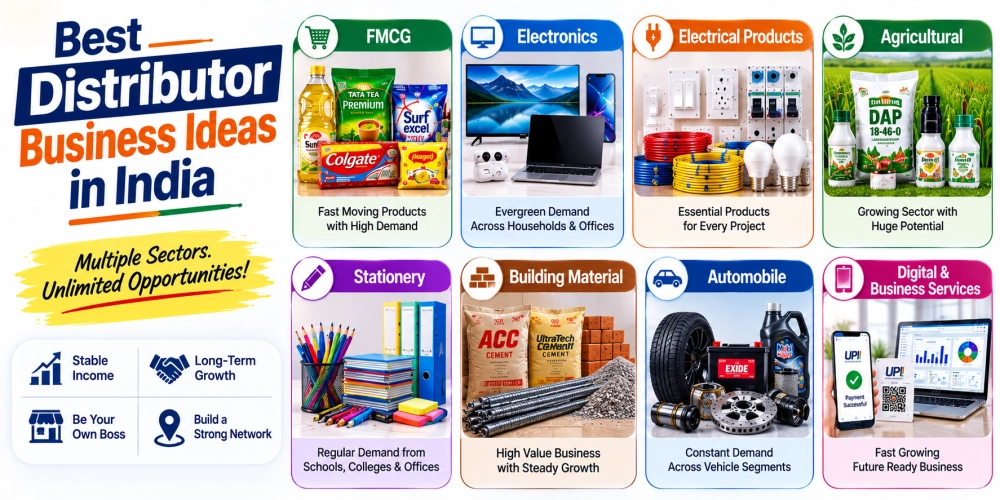
There is no single “best” distributor business for everyone. The right opportunity depends on your investment capacity, location, experience, market network and business goals.
Here are some categories worth researching.
1. FMCG Products Distributorship
FMCG stands for Fast-Moving Consumer Goods. These are products that people purchase frequently. FMCG distribution can have repeat-order potential, but competition can also be high.
Examples include:
- Packaged food
- Beverages
- Personal care products
- Household products
- Grocery-related products
- Cleaning products
2. Electronics Distribution
Technology products can change quickly, so inventory management is particularly important.
Possible categories include:
- Mobile accessories
- Consumer electronics
- Computer accessories
- Small appliances
- Electronic components
3. Electrical Products Distribution
Before entering this category, research local demand, competing brands and product quality.
Examples include:
- LED lighting
- Switches
- Wires
- Electrical accessories
- Small electrical equipment
4. Agricultural Products Distribution
Certain agricultural products may have specific regulatory requirements, so verify the rules applicable to the product and state. Depending on local regulations and company requirements, opportunities may exist in:
- Agricultural tools
- Irrigation equipment
- Farming equipment
- Seeds
- Other agricultural products
5. Stationery Distribution
The business can serve schools, stationery shops, offices and other institutional buyers. Stationery distribution can include:
- Notebooks
- Pens
- Office supplies
- School supplies
- Art materials
6. Building Material Distribution
These businesses may require higher working capital and suitable storage or transportation arrangements. This can include:
- Hardware
- Plumbing products
- Construction accessories
- Electrical materials
- Other building-related products
7. Automobile Products Distribution
Product knowledge and reliable supply can be important in this segment. Possible categories include:
- Automobile accessories
- Spare parts
- Lubricants
- Maintenance products
8. Digital and Business Services Distribution
Distribution is not limited to physical products. Some companies operate through partner, agency, reseller or distributor models for digital services.
Examples can include:
- Business software
- Digital payment-related services
- Recharge and bill payment services
- Financial service platforms
- Other technology-enabled business services
These models may require less physical inventory but can involve different onboarding, compliance and service requirements.
FMCG Products Distributorship: Is It a Good Business?
FMCG distributorship is one of the commonly searched distribution opportunities because consumers purchase many FMCG products regularly. An FMCG distributor typically supplies products to a network of retailers, wholesalers or other businesses.
Why FMCG Distribution Can Be Attractive
- Regular consumer demand
- Repeat purchases
- Large retailer base
- Multiple product categories
- Scope for geographical expansion
But there are also challenges.
Challenges in FMCG Distribution
- Strong competition
- Inventory management
- Product expiry
- Retailer credit
- Transportation costs
- Sales targets
- Working capital requirements
- Existing distributor networks
Therefore, don’t select an FMCG company only because someone promises a high margin. Check the complete business model.
How to Get Distributorship of Any Company?
There is no universal process because every company has its own eligibility requirements and appointment process. However, the following steps can help.
Step 1: Select Your Product Category
First, decide what you want to distribute. Choose a category that you understand and that has demand in your target market.
For example:
- FMCG
- Electrical products
- Electronics
- Healthcare
- Agriculture
- Stationery
- Building materials
- Digital services
Step 2: Research Companies
Find brands and manufacturers operating in your chosen category. Look for official pages containing terms such as:
- Become a Distributor
- Distributor Enquiry
- Dealer Enquiry
- Partner With Us
- Business Opportunity
- Channel Partner
- Distribution Network
Step 3: Check Your Territory
A company may already have a distributor in your city or territory. Never assume that a company will provide territorial exclusivity unless it is clearly mentioned in the agreement.
Ask:
- Is the territory available?
- Is exclusive distribution offered?
- Are there existing distributors?
- What is the expected market coverage?
Step 4: Understand the Investment
Calculate the complete amount required.
This may include:
- Initial inventory
- Security deposit
- Warehouse
- Office
- Transportation
- Staff
- Working capital
- Technology
- Marketing
Step 5: Check Eligibility
Depending on the company, you may need:
- PAN
- Identity documents
- Address proof
- Business bank account
- GST registration, where applicable
- Business registration, where applicable
- Warehouse
- Office
- Sales network
- Relevant experience
Step 6: Apply Through the Official Channel
Use the company’s official website, authorised sales team or official application process. Avoid sending money to an unknown person simply because they claim to represent a popular company.
Step 7: Submit Documents
The company may request documents for verification. Submit documents only through a verified channel.
Step 8: Company Evaluation
The company may evaluate:
- Your location
- Financial capacity
- Market experience
- Infrastructure
- Retail network
- Territory potential
- Business plan
Step 9: Review the Agreement
Before signing, understand:
- Territory
- Margin
- Targets
- Payment terms
- Minimum order
- Returns
- Damaged goods
- Inventory
- Marketing responsibilities
- Termination conditions
Step 10: Start Operations
After approval and completion of the company’s onboarding process, you can begin distribution according to the agreed terms.
Also Read: Best Retail Business in India
What Is Required to Become a Distributor?
Requirements differ between companies, but a distributor may need the following:
Basic Documents
- PAN card
- Aadhaar or other acceptable identity document
- Address proof
- Business bank account
- GST registration, where applicable
- Business registration documents, where applicable
Business Infrastructure
- Office, if required
- Warehouse, if required
- Transportation
- Inventory management system
- Billing system
- Sales staff, depending on the scale
Financial Capacity
You may need sufficient working capital to:
- Purchase stock
- Pay transportation expenses
- Manage retailer credit
- Cover operating expenses
- Handle inventory cycles
Having money for the initial purchase alone is not enough. Working capital is often important for maintaining a distribution business.
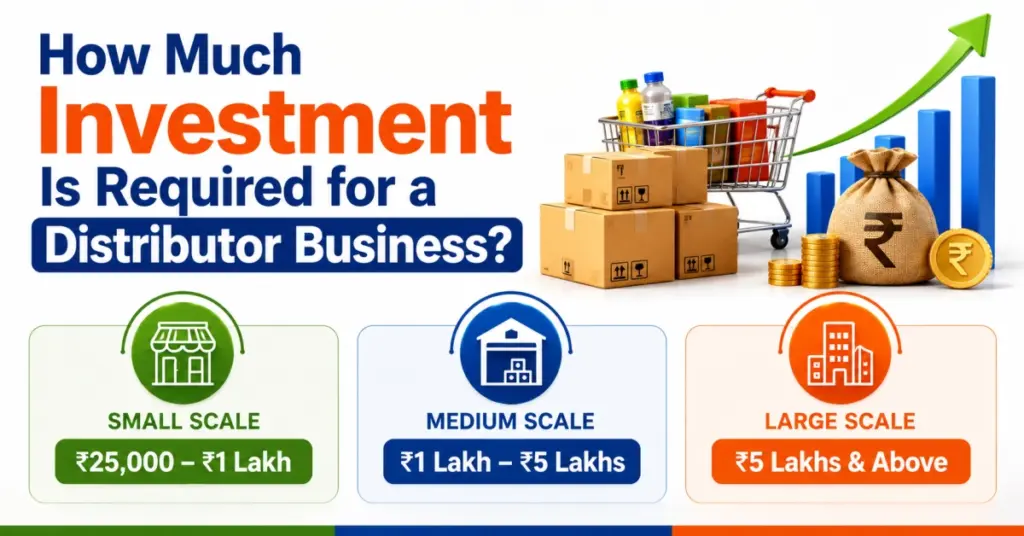
How Much Investment Is Required for a Distributor Business?
There is no single investment amount that applies to every distributor business. A digital service distribution model can have a completely different cost structure from an FMCG or building-material distribution business.
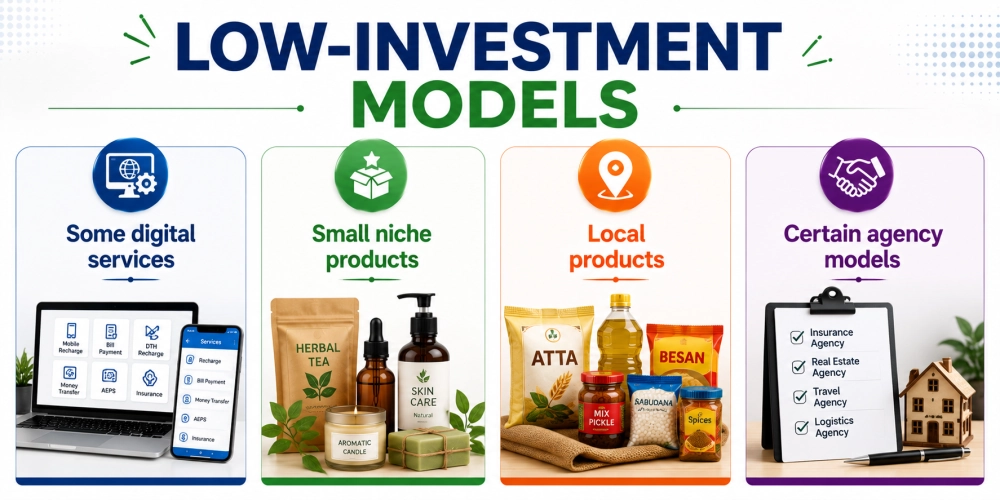
Low-Investment Models
Potential examples include:
- Some digital services
- Small niche products
- Local products
- Certain agency models
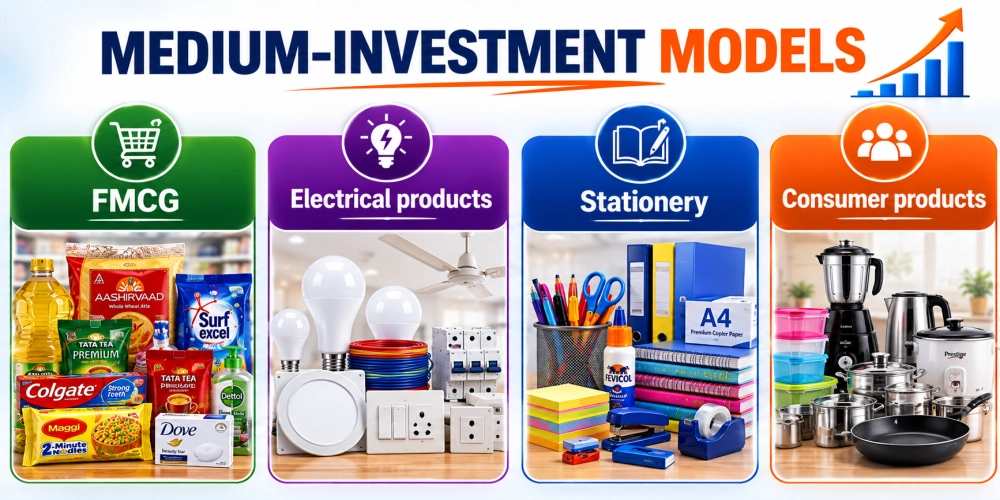
Medium-Investment Models
Examples may include:
- FMCG
- Electrical products
- Stationery
- Consumer products
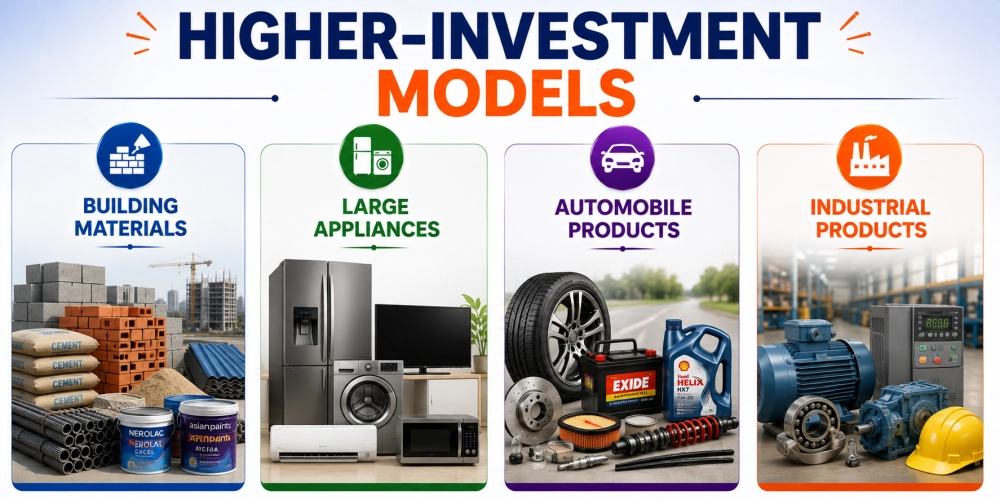
Higher-Investment Models
Examples can include:
- Building materials
- Large appliances
- Automobile products
- Industrial products
Your actual investment should be calculated using:
Total Business Requirement = Initial Inventory + Infrastructure + Working Capital + Operating Expenses + Other Company Charges
Do not calculate your budget only on the basis of a distributorship fee.
Free Distributorship: Is It Really Free?
The term “free distributorship” can be misleading. A company may not charge an upfront distributorship fee, but that does not necessarily mean you can operate the business without capital.
You may still need money for:
- Inventory
- Transportation
- Warehouse
- Staff
- Marketing
- Working capital
- Business compliance
For example, a company may say that it does not charge a distributor appointment fee. However, if you need to purchase stock worth a certain amount to start operations, that stock investment still needs to be considered.
Be Careful With Unrealistic Promises
Avoid opportunities that promise:
- Guaranteed monthly income
- Guaranteed returns
- Guaranteed customers
- Very high profits without business activity
- Immediate approval after payment
- Pressure to transfer money quickly
Always verify the company and commercial terms independently.
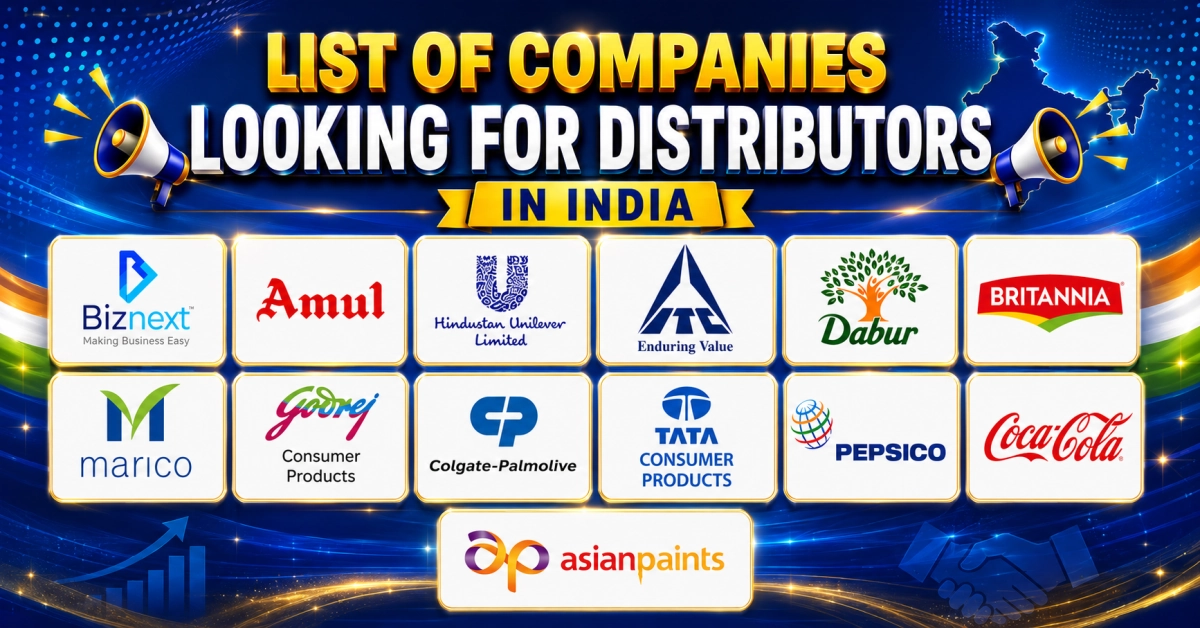
Companies Looking for Distributors in India
There are genuine opportunities in the market, but distributorship availability can change frequently. A company that is looking for distributors today may appoint someone tomorrow.
Therefore, instead of relying on a list, search for current opportunities through official sources.
Where Can You Find Distributor Opportunities?
- Official Company Websites: Check pages such as:
- Become a Distributor
- Partner With Us
- Dealer Network
- Business Enquiry
- Channel Partner
- Trade Exhibitions: Trade fairs can help you connect directly with manufacturers and brands.
- B2B Platforms: B2B marketplaces can help identify manufacturers and suppliers, but independently verify the company before making payments.
- Local Manufacturers: Visit industrial areas and manufacturing clusters in your region.
- Industry Associations: Industry associations can be useful for finding established businesses in specific sectors.
- Retailer Networks: Retailers often know which brands are expanding in their market.
- Company Sales Teams: Contact the company directly and ask whether your territory is available.
Also Read: Companies Looking for Distributors: These companies are actively looking for new distributors.
How to Find Distributor Opportunities Near Me?
If you want a local distributor business, start with your own city and nearby markets.
Local Research Strategy
- Identify products with local demand.
- Search for manufacturers in your area.
- Visit wholesale markets.
- Speak with retailers.
- Identify brands with weak local distribution.
- Contact manufacturers directly.
- Check whether the territory is available.
- Compare at least three to five opportunities.
Example: Someone searching for “distributorship opportunities in Pune” should not simply search for a company name.
Tried to research:
- Pune FMCG distributors
- Pune electrical distributors
- Pune consumer product manufacturers
- Pune wholesale markets
- Maharashtra distribution opportunities
- Manufacturers supplying Pune retailers
This approach can uncover more relevant opportunities.
Distributorship Opportunities in Pune
Pune can be an interesting market for businesses because it combines residential, commercial and industrial demand. However, local competition and operating costs can vary significantly by area.
Someone looking for distributorship opportunities in Pune should evaluate:
- Product demand
- Target customers
- Existing distributors
- Transportation costs
- Warehouse availability
- Competition
- Retailer density
- Nearby markets
- Working capital requirements
Don’t select a distributorship simply because the company says the city has a large market.
The real question is: Can you build a profitable distribution network within your target territory after accounting for all costs?
What Makes the Best Distribution Business?
The “best” distribution business varies from person to person based on skills, experience, and available resources. There is no universal model that guarantees success for everyone.
- FMCG Distribution: Suitable for entrepreneurs with strong retailer networks and experience in fast-moving consumer goods. It offers frequent sales and repeat demand.
- Digital Services Distribution: Ideal for those who prefer low inventory management and want a service-based model with flexible operations.
Key Factors to Evaluate:
- Product Demand: High demand ensures consistent sales opportunities.
- Profit Margin: Directly impacts overall earnings and sustainability.
- Investment Requirement: Determines entry feasibility and scale of business.
- Competition Level: Affects ease of market penetration.
- Working Capital: Ensures smooth daily operations and credit handling.
- Storage Needs: Impacts infrastructure and operational cost.
- Territory Size: Defines market reach and growth potential.
- Company Support: Helps in marketing, logistics, and sales growth.
- Repeat Purchases: Ensures stable recurring revenue.
- Scalability: Supports long-term expansion and profitability.
A strong distribution opportunity should align with your financial capacity, skills, and market understanding rather than just attractive claims or branding.
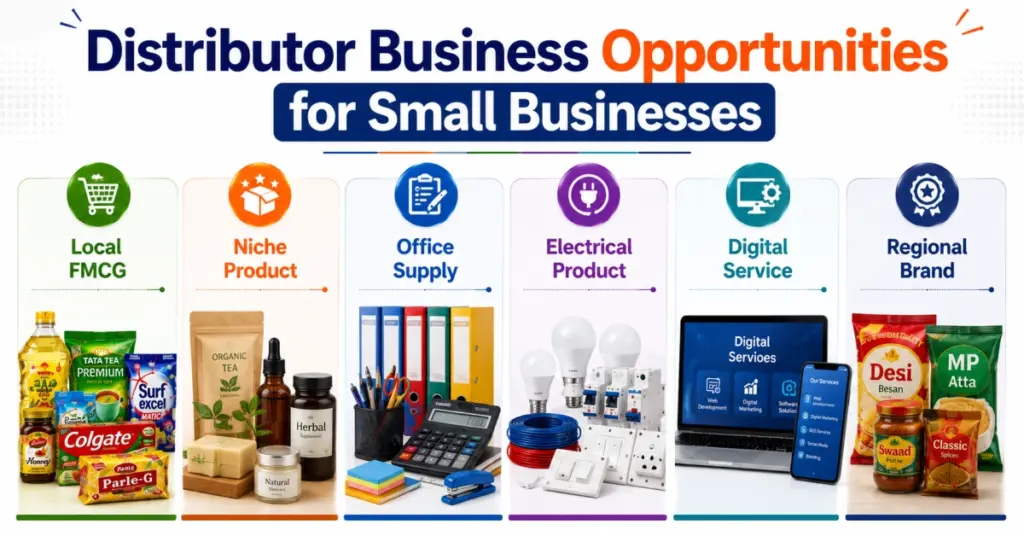
Distributor Business Opportunities for Small Businesses
Small businesses do not necessarily have to compete with large distributors from day one. They can start with a focused product category or smaller territory. Potential ideas include:
- Local FMCG Distribution: Focus on a smaller geographic area and gradually increase retailer coverage.
- Niche Product Distribution: Find products that have specific demand but limited local availability.
- Office Supply Distribution: Supply stationery and office products to businesses, schools and institutions.
- Electrical Product Distribution: Build relationships with electrical shops, contractors and businesses.
- Digital Service Distribution: Explore digital business services where physical inventory is limited or not required.
- Regional Brand Distribution: Some regional manufacturers may be interested in expanding into nearby cities or districts.
The key is to start with a business model that matches your financial capacity and operational ability.
What Is a Distributor Agency Business?
A distributor agency business can involve representing or selling products or services for a company within an agreed territory or market. The exact commercial structure can differ. You may find models based on:
- Commission
- Product margin
- Sales incentives
- Territory representation
- Order generation
- Business referrals
Before joining an agency model, understand exactly how you are paid.
Ask: Do I earn a commission for generating leads, taking orders, selling products or completing transactions?
This distinction can significantly affect the economics of the business.
Also Read: Commission-Based Business in India – Best Way to Earn Commission Income in 2026
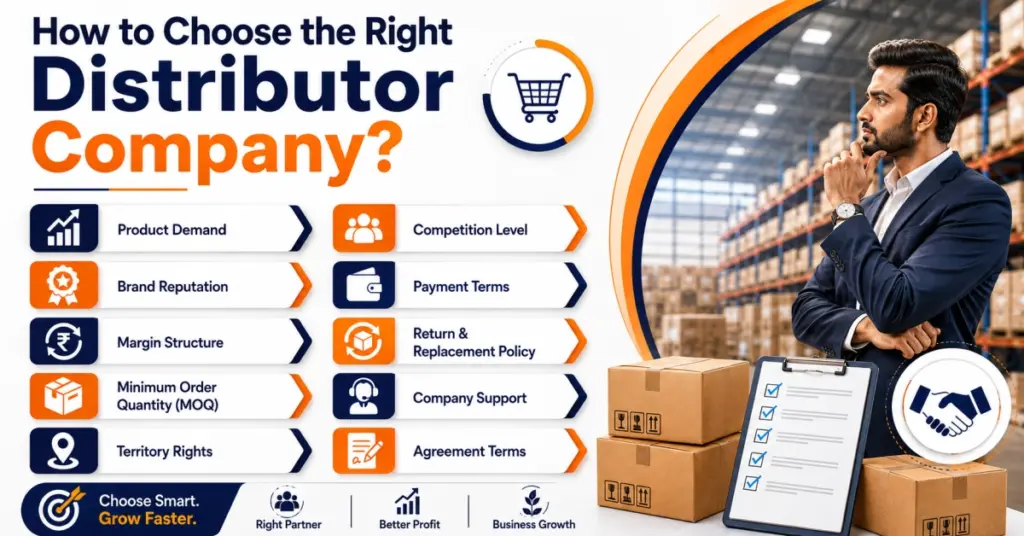
How to Choose the Right Distributor Company?
Choosing the right distributor company is a crucial decision that directly impacts your profitability, stability, and long-term business growth. Do not select a distributorship only based on brand popularity or attractive promises. A proper evaluation is essential before investing.
1. Product Demand
- Check whether the product has consistent market demand in your area.
- Prefer products with regular consumption and repeat purchases.
- Avoid products with seasonal or uncertain demand unless you have strong market knowledge.
2. Brand Reputation
- Research the company’s market presence and customer trust.
- Speak with existing retailers or distributors if possible.
- A strong reputation helps in faster product acceptance.
3. Margin Structure
- Understand the real profit margin after discounts, schemes, and returns.
- Calculate net profit, not just gross margin.
- Ensure margins are sustainable after operational costs.
4. Minimum Order Quantity (MOQ)
- Check the minimum stock requirement to start.
- High MOQ can block your working capital and increase risk.
5. Territory Rights
- Confirm whether you get exclusive or shared territory.
- Understand geographical limits and sales restrictions clearly.
6. Competition Level
- Analyze existing distributors and market saturation.
- High competition may reduce your sales potential.
7. Payment Terms
- Review advance payment, credit period, and settlement cycle.
- Flexible credit terms improve cash flow management.
8. Return & Replacement Policy
- Important for perishable, seasonal, or fast-changing products.
- Check rules for damaged, expired, or unsold stock.
9. Company Support
- Look for marketing support, training, logistics help, and promotional schemes.
- Strong support improves sales performance.
10. Agreement Terms
- Read all legal and financial clauses carefully.
- Seek professional advice if terms are complex or high-risk.
15 Questions to Ask Before Taking a Distributorship
Before you take a distributorship, ask the company:
- What is the total initial investment?
- Is there a security deposit?
- What is the minimum order quantity?
- What is the distributor margin?
- Are there monthly or annual sales targets?
- Is the territory exclusive?
- Are other distributors operating nearby?
- What are the payment terms?
- Is credit available?
- What is the return policy?
- How are damaged products handled?
- What happens to expired inventory?
- Who pays transportation costs?
- What marketing support is provided?
- What happens if the distributorship is terminated?
Getting clear answers before investing can help reduce avoidable business risks.
Distributor Business Profit: How Much Can You Earn?
One of the biggest questions is: “How much can a distributor earn?” There is no universal answer.
Profit depends on:
- Monthly sales
- Gross margin
- Product category
- Retailer network
- Operating expenses
- Working capital
- Credit losses
- Transportation
- Staff costs
- Inventory losses
A simple calculation is: Business Profit = Sales Revenue – Product Cost – Operating Expenses
For example, suppose a distributor generates ₹10 lakh in monthly sales. If the effective gross margin is 8%, the gross margin would be ₹80,000. But that ₹80,000 is not automatically profit.
The distributor may still need to pay for:
- Delivery
- Fuel
- Staff
- Warehouse
- Rent
- Software
- Marketing
- Damaged goods
- Other operating expenses
Therefore: Gross Margin ≠ Net Profit
This is an important calculation to understand before starting any distribution business.
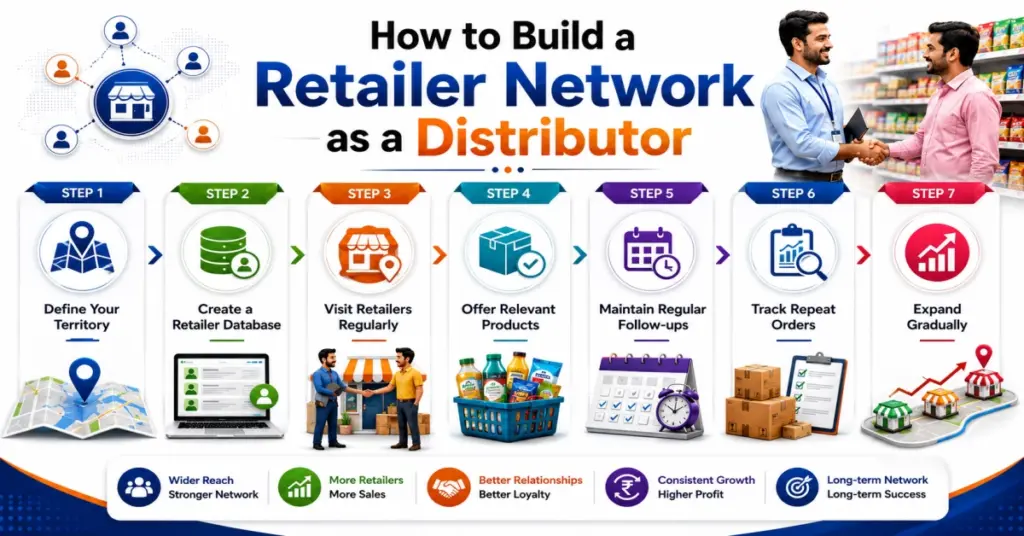
How to Build a Retailer Network as a Distributor
Building a strong retailer network is essential for long-term success in the distribution business. A well-connected network ensures consistent sales, repeat orders, and brand visibility in the market.
Step 1: Define Your Territory
- Clearly divide your market into zones, streets, or clusters.
- Focus on manageable areas to ensure better coverage and control.
- Prioritise high-demand locations with strong retail activity.
Step 2: Create a Retailer Database
Maintain a detailed record of all retailers, including:
- Shop name and exact location
- Owner/manager contact details
- Product categories they deal in
- Existing competing brands
- Purchase frequency and order size
This helps in planning targeted sales strategies.
Step 3: Visit Retailers Regularly
- Introduce your products professionally.
- Highlight key benefits like pricing, quality, and availability.
- Build trust through consistent communication and support.
Step 4: Offer Relevant Products
- Do not push all products to every retailer.
- Understand their customer base and demand.
- Suggest only suitable and fast-moving items.
Step 5: Maintain Regular Follow-ups
- Visit frequently to strengthen relationships.
- Resolve issues quickly to build loyalty.
Step 6: Track Repeat Orders
- Identify high-performing retailers.
- Focus on retention and increasing order value.
Step 7: Expand Gradually
- Once stable, enter nearby areas.
- Scale step-by-step for sustainable growth.
How Technology Can Help a Distributor Business
Technology can simplify many distribution activities. Useful tools can help with:
- Inventory Management: Track:
- Stock
- Sales
- Purchases
- Low-stock products
- Product movement
- Retailer Management: Maintain retailer information and order history.
- Digital Ordering: Allow retailers to submit orders digitally instead of relying entirely on phone calls.
- Payment Management: Track outstanding payments and transaction records.
- Sales Reporting: Measure:
- Daily sales
- Monthly sales
- Product performance
- Retailer performance
- Territory performance
- Customer Communication: WhatsApp Business, email and other digital channels can support regular communication with retailers.
For entrepreneurs who already operate a retailer network, digital business-service platforms can also provide additional services to local businesses. This can be considered alongside traditional distribution, depending on the entrepreneur’s target market and business model.
Distributor Business vs Other Business Opportunities
Distribution is only one possible business model.
| Business Model | Inventory | Investment | Main Revenue Model | Scalability |
|---|---|---|---|---|
| Distributor | Usually required | Medium to high | Margin/commission | High |
| Dealer | Usually required | Medium | Margin | Medium-High |
| Retailer | Required | Low to medium | Margin | Medium |
| Franchise | Depends on model | Medium to high | Sales/revenue | High |
| Digital Services | Low or none | Low to medium | Commission/service revenue | High |
The right choice depends on your experience, capital, location and preferred way of working.
Common Mistakes to Avoid in a Distributor Business
- Choosing Only Based on Margin: Do not select a distributorship just because it offers high profit margins. If the product has low demand or weak market acceptance, sales will remain poor despite good margins.
- Ignoring Market Demand: Always study local customer needs and retailer demand before investing. A product without demand leads to slow movement and financial losses.
- Buying Excess Inventory: Overstocking blocks your working capital and increases storage costs. Start with controlled inventory and scale gradually based on actual sales.
- Ignoring Competition: Analyze existing distributors, brands, and market saturation. High competition can reduce your sales potential and margins.
- Underestimating Working Capital: Ensure sufficient funds for daily operations, credit cycles, transportation, and reorders. Cash flow gaps can disrupt business continuity.
- Not Reading the Agreement: Carefully review all terms including targets, margins, return policies, and territory rights before signing any contract.
- Trusting Unofficial Agents: Always verify company details through official websites or authorized representatives to avoid fraud or misrepresentation.
- Paying Immediately: Avoid urgent payment requests without verification. Genuine companies follow proper onboarding procedures.
- Ignoring Product Returns: Understand policies for damaged, expired, or unsold stock to avoid unexpected losses.
- Starting Without a Sales Plan: A distributor must have a clear strategy for retailer onboarding, sales growth, and customer retention to ensure consistent revenue.
How to Identify Genuine Distributor Opportunities
When searching for distributor opportunities in India, use a verification process.
Check the Company
Look at:
- Official website
- Company information
- Product details
- Official contact information
- Business history
Verify the Opportunity
Ask:
- Is the company actually appointing distributors?
- Is your territory available?
- Is the offer listed on an official company channel?
- What are the exact commercial terms?
Verify Payment Requests
If someone asks for:
- Registration fee
- Security deposit
- Inventory payment
- Documentation fee
Verify the request directly with the company. Do not rely only on a WhatsApp number, social media profile or third-party listing.
Can You Get a Distributorship Without Experience?
Yes, some companies may accept new entrepreneurs, but this depends entirely on their eligibility criteria. A new entrepreneur can improve their chances by demonstrating:
- Financial capacity
- Local market knowledge
- Retailer relationships
- Sales ability
- Infrastructure
- Commitment to the business
- A clear territory plan
Previous distribution experience can help, but it is not necessarily required for every opportunity.
Can a Small Business Become a Distributor?
Yes, depending on the company and product category. Small businesses can focus on:
- One territory
- One product category
- A limited number of SKUs
- Local retailers
- Niche products
- Regional brands
- Digital services
Instead of trying to become a large distributor immediately, build a stable retailer network and expand gradually.
How to Apply for Distributorship?
The application process usually starts with identifying a company that is accepting distributor applications.
A typical application may involve: Research → Enquiry → Eligibility Check → Document Submission → Company Verification → Commercial Discussion → Agreement → Onboarding
Always apply through the company’s official channel whenever possible.
Frequently Asked Questions About Distributor Business
1. What is a distributor business?
A distributor business supplies products or services from manufacturers or brands to retailers, dealers, wholesalers or other customers and earns through an agreed margin, commission or commercial arrangement.
2. Is distributorship profitable in India?
Distributorship can be profitable, but profitability depends on sales volume, margins, product demand, competition, working capital and operating expenses. No company can guarantee a fixed profit merely by offering a distributorship.
3. How do I get a distributorship of a company?
Research companies in your chosen category, check whether your territory is available, review eligibility requirements and apply through the company’s official website or authorised sales channel.
4. How much money is required to start a distributor business?
The investment varies widely. It may include inventory, security deposit, warehouse, transportation, staff and working capital. The required amount depends on the company and product category.
5. Which distributorship is best in India?
There is no single best distributorship. FMCG, electrical, electronics, agriculture, stationery, building materials and digital services can all have opportunities. Choose according to local demand, investment and your business capabilities.
6. How can I find companies looking for distributors?
Check official company websites, distributor enquiry pages, trade exhibitions, B2B networks, industry associations and local manufacturers.
7. Can I get a free distributorship?
Some companies may not charge an upfront distributorship fee, but you may still need working capital, inventory and other business expenses.
8. What documents are required for distributorship?
Requirements vary. Common documents may include PAN, identity proof, address proof, business bank account and GST or business registration documents where applicable.
9. How can I become a distributor?
Select a category, identify suitable companies, check territory availability, meet eligibility requirements, submit an application and complete the company’s verification and agreement process.
10. What is the difference between distributor and dealer?
A distributor generally focuses on supplying products through a larger local or regional network, while a dealer may sell products directly to customers or operate under a company’s specific dealership arrangement. Exact roles vary by company.
11. How do distributors make money?
Distributors generally earn through product margins, commissions, incentives or other commercial arrangements agreed with the company.
12. Can I start a distributor business with low investment?
Some categories may have lower investment requirements, especially certain digital or niche business models. Traditional product distribution can require more working capital because of inventory and logistics.
13. How do I find distributor opportunities near me?
Search for manufacturers and brands operating in your city, contact their sales teams, explore local wholesale markets and check official distributor application pages.
14. How can I find distributorship opportunities in Pune?
Research companies expanding in Pune and Maharashtra, visit local trade networks, identify manufacturers and contact brands directly about territory availability.
15. How do I take distributorship of any company?
There is no single process for every company. You need to identify the company’s distributor policy, check eligibility, apply through its official channel and complete the company’s approval process.
16. Which products are best for distribution?
Products with consistent demand, reasonable margins, manageable inventory requirements and good repeat-purchase potential can be attractive. The right category depends on your market.
17. What are the best FMCG distributorship opportunities?
Look for FMCG brands with genuine consumer demand, sustainable margins, reasonable inventory requirements, good retailer acceptance and reliable company support.
18. Are companies currently looking for distributors in India?
Companies may continuously add or replace distributors as they expand into new territories. Since requirements change, verify current availability directly with the company.
19. What should I check before paying a distributorship fee?
Verify the company, official contact, agreement, payment purpose, refund terms, territory and commercial conditions. Never make a payment solely because an unofficial person says that a company is urgently looking for distributors.
20. Do distributors need GST registration?
GST requirements depend on the nature and scale of the business and applicable tax rules. Check the current requirements for your specific business and state.
21. Do I need a warehouse to become a distributor?
Some physical-product distribution businesses require storage, while others may operate through different logistics models. Confirm the infrastructure requirement with the company.
22. Can I become a distributor without experience?
Some companies may consider new entrepreneurs. Financial capacity, local market knowledge, infrastructure and sales capability can help.
23. What are the risks of starting a distribution business?
Major risks include slow-moving inventory, competition, low margins, retailer credit, damaged or expired products, high operating costs and changes in product demand.
24. What is a distributor agency?
A distributor agency may represent a company or sell its products/services under an agreed commercial arrangement. The exact commission, territory and responsibilities depend on the agreement.
25. How can I find manufacturers looking for distributors?
Research manufacturers in your target industry, check their official websites, contact sales departments, attend trade exhibitions and explore industry networks.
Distributor Business: Final Checklist Before You Invest
Before taking any distributorship, check the following:
- Research product demand
- Verify the company
- Check territory availability
- Research existing competition
- Calculate total investment
- Keep sufficient working capital
- Understand distributor margin
- Check minimum order quantity
- Understand payment terms
- Check return and replacement policies
- Understand inventory requirements
- Check transportation responsibilities
- Review marketing support
- Read the distributor agreement
- Verify all payment requests
- Apply through an official channel
- Prepare a retailer acquisition plan
- Calculate expected operating expenses
- Compare multiple opportunities before deciding
Conclusion
A distributor business can be a practical business model for entrepreneurs who want to work with established products or services instead of creating their own product from scratch. Opportunities can exist across FMCG, electronics, electrical products, agriculture, healthcare, stationery, building materials, automobile products and digital services.
However, the success of a distributorship depends on much more than the brand name or advertised margin.
Before you get a distributorship, carefully evaluate product demand, territory, competition, initial investment, working capital, margins, inventory requirements, company support and agreement terms.
If you are searching for companies looking for distributors in India, avoid relying only on old lists or unverified advertisements. Use official company websites, verified business contacts, trade networks and direct enquiries to confirm whether a genuine opportunity is currently available.
Similarly, if you are searching for distributorship opportunities near me, start with your local market. Understanding the retailers, customers and competitors in your own territory can be more valuable than simply choosing a company with an attractive offer.
The best distribution business is ultimately the one that fits your budget, market, skills, product demand and long-term business goals.