
 AePS
AePS UPI Cash Withdrawal
 Micro ATM
 Money Transfer
 Banking Services
 Loan
Loan Credit Card Agent
 Payment Solutions
 Mobile Recharge
 Utility Bill Payment
 DTH Recharge
 Wi-Fi Service Partner
 Cash and EMI Collection
 IRCTC Booking
 Bus Ticket Agent
 Courier Service Point
 health insurance
 Hospicash Insurance
 Bike Insurance
 Car Insurance
 PAN Card Agent
 Digital Gold Seller
 Gift Card
 Solar Installation
Filing your Income Tax Return (ITR) on time is one of the most important financial responsibilities for every taxpayer in India. Whether you are a salaried employee, freelancer, business owner, professional, or company, knowing the ITR filing last date helps you avoid late fees, interest charges, and unnecessary legal complications.
Every year, the Income Tax Department announces different due dates based on the type of taxpayer and the applicable ITR form. While many taxpayers wait until the last moment, filing your return early offers several benefits, such as faster tax refunds, fewer technical issues on the portal, and sufficient time to correct any errors.
For the Assessment Year (AY) 2026-27, taxpayers should carefully check the applicable deadline according to their category. If the government extends the filing deadline through a notification from the Central Board of Direct Taxes (CBDT), the revised due date will apply.
In this comprehensive guide, you’ll learn:
- The ITR filing last date for AY 2026-27
- Due dates for salaried employees, individuals, companies, and audit cases
- ITR-1 and ITR-2 filing deadlines
- What happens if you miss the due date
- Latest updates regarding extensions
- Tips to file your ITR without mistakes
Let’s begin by understanding the official due dates.
What is the ITR Filing Last Date for AY 2026-27?
The ITR filing last date refers to the final date by which eligible taxpayers must submit their Income Tax Return for a particular financial year. Filing your return before this deadline ensures compliance with tax laws and helps you avoid penalties.
For AY 2026-27 (Financial Year 2025-26), the due date depends on whether your accounts require an audit and the type of taxpayer you are.
ITR Filing Last Date 2026 (AY 2026-27)
| Taxpayer Category | Applicable ITR Forms | Due Date* |
|---|---|---|
| Individuals, Salaried Employees, HUFs (Non-Audit Cases) | ITR-1, ITR-2, ITR-4 | 31 July 2026 |
| Businesses & Professionals Requiring Tax Audit | ITR-3, ITR-5 | As notified by the Income Tax Department |
| Companies Requiring Audit | ITR-6 | As notified by the Income Tax Department |
| Trusts & Institutions | ITR-7 | As applicable under the Income Tax Act |
| Belated Return | Applicable Forms | Within the permitted timeline under the Income Tax Act |
| Revised Return | Applicable Forms | Before the applicable statutory deadline |
| Updated Return (ITR-U) | Eligible Taxpayers | Up to the period allowed under Section 139(8A) |
Note: The due dates for audit cases, companies, and other special categories may change through official CBDT notifications. Always verify the latest dates on the Income Tax Department’s e-filing portal before filing your return.
Why Filing Before the Due Date Matters
Submitting your ITR before the deadline offers several benefits:
- Avoid late filing fees and interest.
- Receive tax refunds faster.
- Carry forward eligible business or capital losses.
- Improve your financial profile for loans and visas.
- Reduce the chances of portal errors caused by last-minute rush.

ITR Filing Last Date for Salaried Employees
If you earn income through salary or pension, you generally fall under the category of individual taxpayers. Most salaried individuals file their returns using ITR-1 (Sahaj) or ITR-2, depending on their income sources.
For most salaried taxpayers who are not subject to tax audit, the ITR filing last date is 15 September 2026 for AY 2026-27.
Who Can File ITR-1?
ITR-1 is generally suitable for resident individuals with:
- Salary or pension income
- Income from one house property
- Income from other sources such as bank interest
- Agricultural income up to the prescribed limit
- Total income within the eligibility criteria specified by the Income Tax Department
Documents Required
Before filing your return, keep these documents ready:
- PAN Card
- Aadhaar Card
- Form 16 from your employer
- Form 26AS
- Annual Information Statement (AIS)
- Tax Information Statement (TIS)
- Bank account details
- Investment proofs (if applicable)
Why Salaried Employees Should File Early
Filing your return early offers several advantages:
- Faster processing of refunds.
- Enough time to correct mistakes.
- Reduced portal congestion.
- Easy verification of Form 16 with AIS and Form 26AS.
- Better financial documentation for loans and visa applications.
Many taxpayers wait until the last week to file their return, but early filing helps avoid unnecessary stress and technical issues.
Last Date to File ITR for Individual Taxpayers
Individual taxpayers include more than just salaried employees. Freelancers, consultants, pensioners, self-employed professionals, and people earning rental or investment income also need to file Income Tax Returns.
The last date to file ITR for individual taxpayers depends on whether their accounts require a tax audit.
Individuals Covered Under This Category
- Salaried employees
- Pensioners
- Freelancers
- Consultants
- Doctors
- Chartered Accountants
- Architects
- Small business owners
- Individuals earning rental income
- Investors with capital gains
If your accounts are not subject to tax audit, you should file your return by the applicable due date announced for non-audit taxpayers.
Individual vs HUF vs Business
Understanding your taxpayer category is important because each has different compliance requirements.
| Category | Description |
|---|---|
| Individual | Single taxpayer filing personal income tax return |
| HUF | Hindu Undivided Family filing separately |
| Business | Proprietorship or business income requiring different ITR forms |
Choosing the correct ITR form and filing before the deadline helps avoid notices and processing delays.
Company ITR Filing Last Date
Companies registered in India are also required to file Income Tax Returns every year, even if they have not earned significant profits during the financial year.
The applicable due date depends on whether the company is required to get its accounts audited under the Income Tax Act.
Who Needs to File Company ITR?
The following entities generally fall under this category:
- Private Limited Companies
- Public Limited Companies
- One Person Companies (OPC)
- Limited Liability Partnerships (LLPs)
- Partnership Firms
- Foreign Companies operating in India
Companies generally file their returns using ITR-6, while partnership firms commonly use ITR-5.
Important Compliance Requirements
Companies should ensure:
- Books of accounts are updated.
- Financial statements are finalised.
- Tax audit (if applicable) is completed.
- Advance tax liabilities are cleared.
- TDS returns are correctly filed.
- GST reconciliation is completed wherever applicable.
Missing the filing deadline may result in late fees, interest, and other compliance issues.
ITR-1 Filing Last Date
ITR-1 (Sahaj) is the most commonly used Income Tax Return form in India. It is designed for eligible resident individuals with relatively simple income sources.
For AY 2026-27, eligible taxpayers should file ITR-1 by the due date prescribed for non-audit individual taxpayers.
Who Should File ITR-1?
You may be eligible to file ITR-1 if you have:
- Salary income
- Pension income
- One house property
- Income from savings accounts and fixed deposits
- Family pension (subject to eligibility)
- Agricultural income within the prescribed limit
Benefits of Filing ITR-1 on Time
- Quick processing
- Faster tax refunds
- Easy online filing
- Lower chances of errors
- Better financial records
Always verify your Form 16, AIS, and Form 26AS before submitting your return to ensure the information matches.
ITR-2 Filing Last Date
If your income is more complex, you may need to file ITR-2 instead of ITR-1.
ITR-2 is generally applicable to individuals and Hindu Undivided Families (HUFs) who do not have business income but earn income from other sources.
Who Should File ITR-2?
ITR-2 is commonly used by taxpayers with:
- Capital gains from shares or property
- Income from more than one house property
- Foreign income or foreign assets
- Agricultural income exceeding the prescribed limit
- High-value investments
- Director in a company (where applicable)
- ESOP-related disclosures (where applicable)
Since ITR-2 requires more disclosures than ITR-1, taxpayers should carefully review all income details before filing.
Filing early gives sufficient time to reconcile capital gains statements, broker reports, and AIS data.
Audited ITR Filing Last Date
Some taxpayers are required to undergo a tax audit before filing their Income Tax Return. In such cases, the due date for filing the ITR is different from that of non-audit taxpayers.
Tax audits help verify that the books of accounts are accurate and comply with the Income Tax Act.
Who Requires a Tax Audit?
A tax audit may apply to:
- Businesses crossing the prescribed turnover limits
- Professionals exceeding the prescribed gross receipts limits
- Certain taxpayers opting in or out of presumptive taxation schemes
- Other cases specified under the Income Tax Act
Since tax audits involve preparing audited financial statements and audit reports, taxpayers should start the process well before the due date.
Tips for Audit Cases
- Maintain proper books of accounts throughout the year.
- Reconcile GST, TDS, and financial records.
- Coordinate with your Chartered Accountant early.
- Complete the audit before the ITR filing deadline.
- File the return promptly after the audit report is submitted.
Proper planning helps businesses avoid last-minute delays, penalties, and compliance issues.
Has the ITR Filing Last Date Been Extended?
One of the most searched questions every tax season is whether the ITR filing last date has been extended. In previous years, the Central Board of Direct Taxes (CBDT) has extended the due date in certain situations, such as technical issues on the Income Tax e-filing portal, major tax law changes, or exceptional circumstances affecting taxpayers.
However, taxpayers should never assume that the deadline will be extended. It is always advisable to file your Income Tax Return (ITR) before the original due date to avoid last-minute stress and penalties.
How to Check if the ITR Filing Last Date is Extended
To stay updated with the latest announcements:
- Visit the official Income Tax e-Filing Portal.
- Check CBDT notifications and circulars.
- Follow official announcements from the Income Tax Department on verified channels.
- Refer to reliable financial news sources for updates.
Important: Until an official notification is issued by the CBDT, taxpayers should consider the existing due date as final.
Why You Should Not Wait for an Extension
Many taxpayers delay filing in the hope of an extension. This can create unnecessary problems if no extension is announced. Filing early offers several advantages:
- Avoid heavy traffic on the e-filing portal.
- Receive tax refunds sooner.
- Get enough time to correct errors.
- Prevent late filing fees and interest.
- Reduce the risk of missing the deadline.
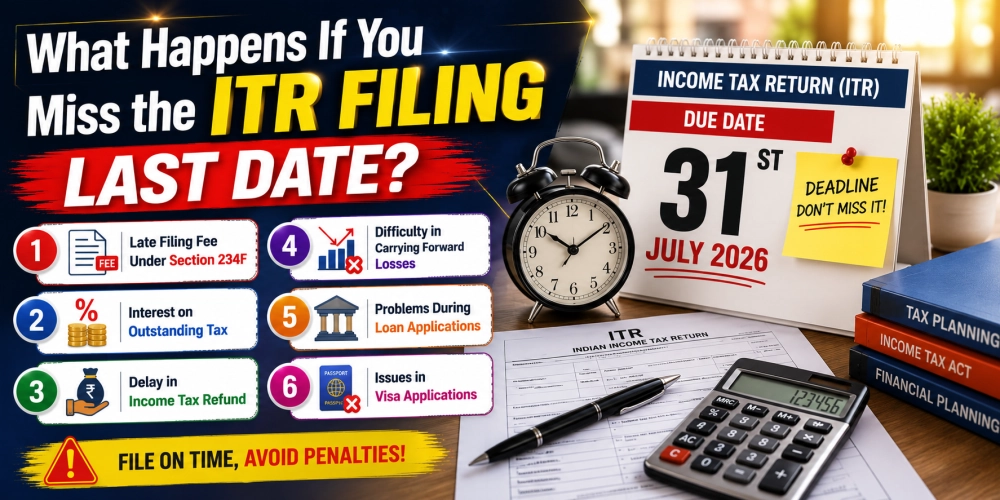
What Happens If You Miss the ITR Filing Last Date?
Missing the ITR filing last date can lead to financial penalties and compliance issues. Even if you do not have any tax payable, delaying your return may impact future financial activities.
Below are some important consequences of filing your ITR after the due date.
1. Late Filing Fee Under Section 234F
If you file your Income Tax Return after the prescribed due date, you may have to pay a late filing fee under Section 234F of the Income Tax Act, subject to the applicable provisions.
The amount depends on factors such as:
- Your total income.
- The date on which you file your return.
- The provisions applicable for the relevant assessment year.
2. Interest on Outstanding Tax
If any income tax remains unpaid, interest may be charged under the applicable provisions of the Income Tax Act until the outstanding tax is paid.
This increases your total tax liability and can become costly if the delay is significant.
3. Delay in Income Tax Refund
Many salaried employees and taxpayers expect an income tax refund after filing their return.
If you file your ITR late:
- Refund processing may be delayed.
- Verification may take longer.
- Any mistakes may further postpone the refund.
4. Difficulty in Carrying Forward Losses
Certain losses, such as business losses or capital losses, can generally be carried forward only if the Income Tax Return is filed within the prescribed due date, subject to applicable tax provisions.
Missing the deadline may result in losing this benefit.
5. Problems During Loan Applications
Banks and financial institutions often ask for:
- Income Tax Returns of the last 2–3 years
- Income proof
- Financial statements
A delayed or missing ITR may affect:
- Home loan approval
- Personal loan approval
- Business loan processing
- Credit assessment
6. Issues in Visa Applications
Many foreign embassies request Income Tax Returns while processing visa applications.
Timely filed ITRs help demonstrate:
- Stable income
- Financial credibility
- Tax compliance
Consequences of Missing the ITR Filing Deadline
| Consequence | Impact |
|---|---|
| Late Filing Fee | Additional cost under applicable provisions |
| Interest on Tax | Increased tax liability |
| Refund Delay | Slower refund processing |
| Carry Forward of Losses | May not be available in certain cases |
| Loan Applications | Financial documents may be affected |
| Visa Processing | Income proof may become difficult |
ITR Filing Last Date with Late Fee
If you miss the original due date, you may still be able to file a belated return within the period permitted under the Income Tax Act. However, filing after the due date may attract a late filing fee and other consequences.
The applicable late fee depends on the provisions of the Income Tax Act and your taxable income.
General Late Fee Structure
| Taxable Income | Applicable Late Fee* |
|---|---|
| Up to the prescribed threshold | Lower fee as per applicable provisions |
| Above the prescribed threshold | Higher fee as prescribed under Section 234F |
Note: The exact fee and conditions may vary based on the relevant assessment year and applicable tax rules. Always check the latest Income Tax Department guidelines.
Additional Costs You May Incur
Apart from the late filing fee, taxpayers may also have to pay:
- Interest on unpaid taxes.
- Self-assessment tax, if applicable.
- Any additional tax liability arising from delayed filing.
Can You File ITR After the Last Date?
Yes. Missing the original due date does not always mean you lose the opportunity to file your Income Tax Return.
The Income Tax Act provides options such as:
- Belated Return
- Revised Return
- Updated Return (ITR-U)
Each option has different eligibility conditions and timelines.
Belated Return
A Belated Return is filed after the original due date but within the time permitted under the Income Tax Act.
When Should You File a Belated Return?
You can consider filing a belated return if:
- You forgot to file your ITR on time.
- You were waiting for certain tax documents.
- You missed the deadline due to unavoidable circumstances.
Important Points
- A late filing fee may apply.
- Interest may also be payable, where applicable.
- Certain tax benefits may not be available.
Revised Return
Suppose you have already filed your Income Tax Return but later discover an error.
Common mistakes include:
- Wrong bank account details
- Incorrect income
- Missing deductions
- Incorrect TDS details
- Calculation mistakes
In such cases, you can generally file a Revised Return within the period allowed under the Income Tax Act.
A revised return helps taxpayers correct genuine mistakes and maintain accurate tax records.
Updated Return (ITR-U)
The Updated Return (ITR-U) allows eligible taxpayers to update their tax return even after the time limit for filing a revised or belated return has passed, subject to the conditions specified under Section 139(8A) of the Income Tax Act.
It can be useful when:
- You forgot to report certain income.
- Additional tax needs to be paid.
- Errors are discovered later.
- You want to voluntarily comply with tax regulations.
However, an updated return cannot be filed in every situation. Certain restrictions and additional tax may apply.
Difference Between Original, Belated, Revised & Updated Return
The Income Tax Act provides different types of returns depending on when you file and whether you need to make corrections. Understanding the difference helps you choose the right option and avoid unnecessary penalties.
| Return Type | When to File | Purpose | Late Fee |
|---|---|---|---|
| Original Return | On or before the due date | First-time filing of ITR | No |
| Belated Return | After the due date but within the permitted timeline | File ITR after missing the due date | Applicable as per the Income Tax Act |
| Revised Return | Within the prescribed time after filing the original return | Correct mistakes in the filed return | No additional late fee if the original return was filed on time |
| Updated Return (ITR-U) | Within the period allowed under Section 139(8A) | Voluntarily update income or tax details | Additional tax may apply |
Tip: If you discover any mistakes after filing your return, don’t panic. File a revised return within the permitted timeline to correct the errors.
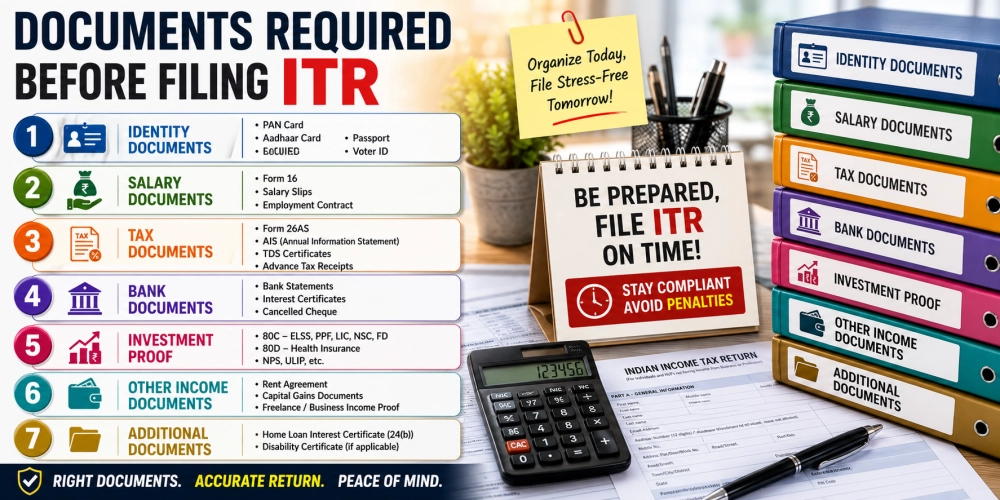
Documents Required Before Filing ITR
Keeping all documents ready before starting your Income Tax Return makes the filing process much easier and reduces the chances of mistakes.
Identity Documents
- PAN Card
- Aadhaar Card
Salary Documents
- Form 16
- Salary slips (if required)
Tax Documents
- Form 26AS
- Annual Information Statement (AIS)
- Tax Information Statement (TIS)
Bank Documents
- Savings account statement
- Fixed Deposit interest certificate
- Passbook or bank statement
Investment Proof
- ELSS investments
- PPF contribution
- LIC premium receipts
- Health insurance premium receipts
- Home loan interest certificate
Other Income Documents
- Capital gains statement from your broker
- Rental income details
- Dividend income
- Interest certificates from banks
- Foreign income details (if applicable)
Additional Documents
- Previous year’s ITR (for reference)
- Aadhaar-linked mobile number
- Active email ID
- Pre-validated bank account
Step-by-Step Process to File ITR Online
The Income Tax Department has made online ITR filing simple and convenient. Most taxpayers can complete the process in a short time if all documents are ready.
Step 1: Visit the Income Tax e-Filing Portal
Go to the official Income Tax Department’s e-filing portal and log in using your PAN (or Aadhaar, where applicable) and password.
Step 2: Select the Assessment Year
Choose: Assessment Year: AY 2026-27
Ensure you select the correct assessment year corresponding to the financial year for which you are filing the return.
Step 3: Choose the Correct ITR Form
Select the appropriate form based on your income source.
Examples:
| Income Type | Common ITR Form |
|---|---|
| Salary Income | ITR-1 |
| Capital Gains | ITR-2 |
| Business Income | ITR-3 |
| Presumptive Income | ITR-4 |
Choosing the wrong form may result in a defective return or additional compliance requirements.
Step 4: Verify Personal Information
Check:
- Name
- PAN
- Aadhaar
- Address
- Mobile number
- Email ID
- Bank account details
Any incorrect information should be updated before submission.
Step 5: Verify AIS and Form 26AS
Compare the details in your return with:
- Form 26AS
- AIS
- TIS
- Form 16
This helps ensure that your income, TDS, and tax payments match the records available with the Income Tax Department.
Step 6: Claim Deductions
Enter eligible deductions under the applicable provisions of the Income Tax Act, such as investments, insurance premiums, and other eligible expenses.
Review all entries carefully to avoid missing any legitimate tax benefits.
Step 7: Calculate Tax Liability
The portal will automatically calculate:
- Tax payable
- Interest (if applicable)
- Refund amount (if any)
If additional tax is payable, complete the payment before submitting the return.
Step 8: Submit the Return
After reviewing all details, submit your Income Tax Return.
Before clicking the final submit button, verify:
- Income details
- TDS details
- Bank account
- Deductions
- Tax computation
Step 9: Complete e-Verification
Your ITR filing is considered complete only after successful e-verification.
You can verify your return using available methods, such as Aadhaar OTP, net banking, or other options provided on the e-filing portal.
After successful verification, download and save the ITR Acknowledgement (ITR-V) for your records.
Common Mistakes to Avoid While Filing ITR
Many taxpayers make simple mistakes that can delay processing or lead to notices from the Income Tax Department.
Avoid these common errors:
- Selecting the wrong ITR form.
- Entering incorrect PAN or Aadhaar details.
- Not matching income with AIS and Form 26AS.
- Forgetting to report bank interest or other income.
- Claiming deductions without supporting documents.
- Missing the e-verification step.
- Waiting until the last day to file the return.
By filing early and carefully reviewing your information, you can ensure a smooth and hassle-free tax filing experience.
Common Reasons Why People Miss the ITR Filing Last Date
Despite reminders from employers, Chartered Accountants, and the Income Tax Department, many taxpayers still miss the ITR filing deadline every year.
Some of the most common reasons include:
- Waiting for Form 16: Many salaried employees delay filing because they are waiting for Form 16 from their employer.
- Incorrect AIS or Form 26AS: Some taxpayers wait until discrepancies in AIS, TIS, or Form 26AS are resolved.
- Missing Investment Documents: Failure to collect documents related to tax-saving investments often delays filing.
- Last-Minute Filing: Waiting until the final day can lead to portal congestion, slow loading, or technical issues.
- Lack of Awareness: Many first-time taxpayers are unaware of the applicable due date or the correct ITR form.
- Bank Account Not Validated: An unvalidated bank account may delay refunds and create additional filing issues.
- Complex Income Sources: Taxpayers with capital gains, foreign assets, rental income, or business income may require additional time to gather and reconcile financial information.
Tips to File ITR Before the Last Date
Filing your Income Tax Return early can save both time and money. Here are some practical tips to ensure a smooth filing experience:
1. Keep All Documents Ready
Collect essential documents such as:
- PAN
- Aadhaar
- Form 16
- Form 26AS
- AIS
- TIS
- Investment proofs
- Bank statements
2. Verify Your Income
Cross-check your salary, interest income, rental income, capital gains, and other earnings with AIS and Form 26AS before submitting the return.
3. Choose the Correct ITR Form
Selecting the wrong ITR form can lead to a defective return and delay processing.
4. Validate Your Bank Account
Ensure your bank account is pre-validated on the Income Tax e-filing portal to receive refunds without delays.
5. Check Your PAN and Aadhaar Details
Verify that your PAN, Aadhaar, mobile number, and email ID are correct and updated.
6. Don’t Wait Until the Last Day
The Income Tax portal experiences heavy traffic near the deadline. Filing early reduces the chances of technical issues.
7. Complete e-Verification
Submitting the return is not enough. Complete e-verification using Aadhaar OTP, net banking, or other available methods to successfully complete the filing process.
Latest Government Updates on ITR Filing Due Dates
The Income Tax Department and the Central Board of Direct Taxes (CBDT) periodically issue notifications regarding ITR filing deadlines and related compliance requirements.
Taxpayers should regularly check official updates for:
- Extension of ITR filing due dates (if any)
- Changes in ITR forms
- New tax rules
- E-filing portal updates
- Important circulars and notifications
Instead of relying on social media or unofficial sources, always verify information through the official Income Tax Department website.
Turn Tax Season into a Business Opportunity with Biznext
Every year, millions of individuals, salaried employees, freelancers, and small business owners need help filing their Income Tax Returns and GST returns. While many taxpayers struggle with choosing the right ITR form, claiming deductions, or understanding tax rules, you can turn this demand into a profitable income opportunity with Biznext.
By becoming a Biznext Retailer, you can offer professional Income Tax Return (ITR) Filing and GST Registration & GST Return Filing services from your shop or office without needing to be a tax expert. Biznext provides a simple digital platform, dedicated support, and trained professionals to help you serve customers efficiently.

Why Start an ITR & GST Filing Service with Biznext?
- Earn commission on every successful ITR filing.
- Offer GST registration and monthly/quarterly GST return filing services.
- Attract more customers to your existing shop or CSC centre.
- Increase repeat business during every tax season.
- No need for advanced tax knowledge; Biznext support is available whenever needed.
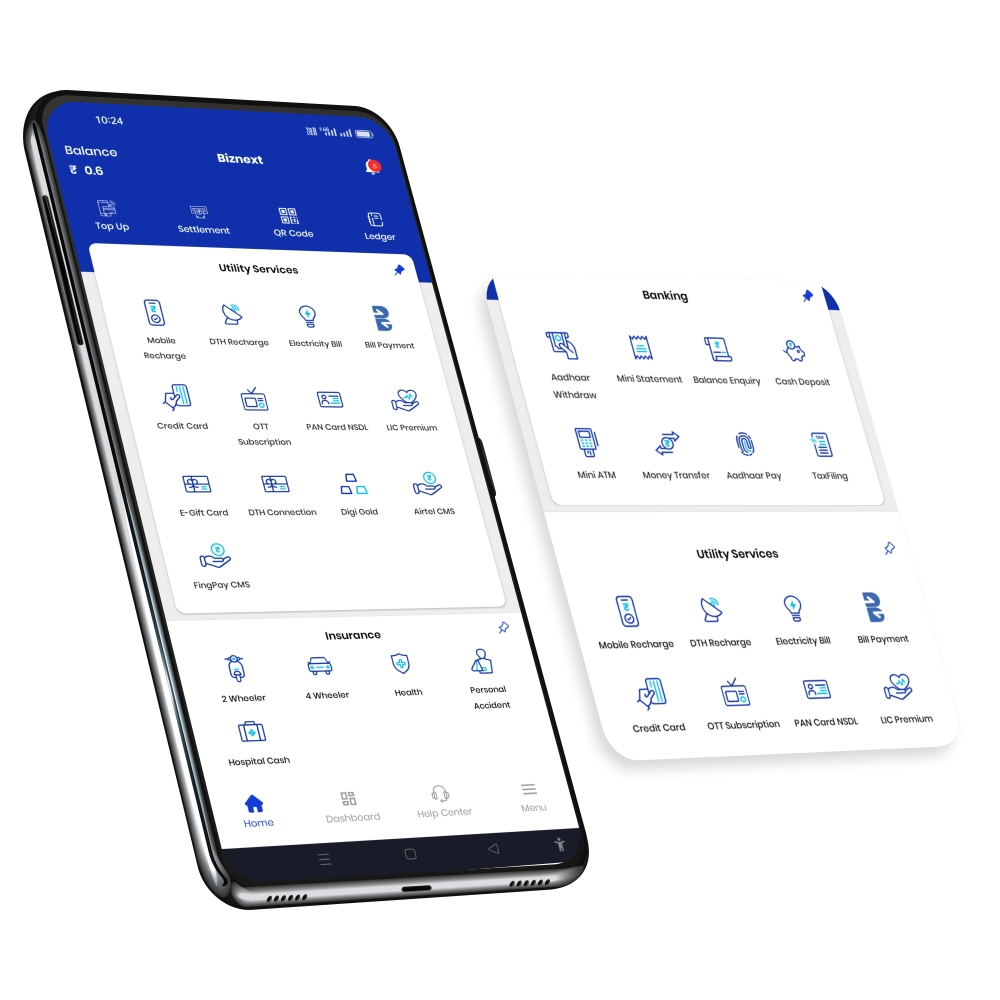
- Provide multiple financial services from one platform, including AEPS, Money Transfer, Bill Payments, PAN Card, Banking Services, Insurance, and Tax & GST Filing.
Who Can Start This Business?
Almost anyone can start earning by becoming a Biznext Retailer. Whether you own a kirana store, CSC or Digital Seva Centre, cyber café, mobile recharge shop, or work as a Banking Correspondent (BC), AEPS agent, insurance agent, accountant, or freelancer, you can easily add Income Tax Return (ITR) filing and GST services to your existing business.
Even students looking for a part-time income and aspiring entrepreneurs can take advantage of this opportunity to build a digital financial services business.
With Biznext’s easy-to-use platform and dedicated support, you can offer professional tax and GST filing services to your customers, increase footfall to your shop, create repeat business, and earn additional commission alongside other services such as AEPS, money transfer, bill payments, PAN card services, insurance, and banking solutions.

Services You Can Offer
As a Biznext Retailer, you can provide:
- Income Tax Return (ITR) Filing
- GST Registration
- GST Return Filing
- PAN Card Services
- Business Registration Support
- Banking & Financial Services
- Utility Bill Payments
- Money Transfer
- AEPS Cash Withdrawal
- UPI Cash Withdrawal
- Insurance & Loan Services
This allows you to earn from multiple services throughout the year instead of relying only on seasonal tax filing.
Why Tax Filing Is a Profitable Seasonal Business
The period between April and September sees a significant increase in demand for ITR filing services, while GST compliance is required throughout the year. This creates two reliable income streams:
| Service | Demand |
|---|---|
| Income Tax Return (ITR) Filing | High (Tax Season) |
| GST Registration | Year-Round |
| GST Return Filing | Monthly & Quarterly |
| PAN Card Services | Year-Round |
| Financial Services | Throughout the Year |
By offering these services from your shop, you can attract new customers, increase footfall, and build long-term relationships that lead to repeat business.
Start Your Tax & GST Service Business with Biznext
Whether you already run a retail shop or want to start a digital financial service business, Biznext makes it easy to expand your offerings. With a single platform, you can help customers file their Income Tax Returns, complete GST compliance, and access a wide range of financial services—all while earning attractive commissions.
👉 Register as a Biznext Retailer today and turn tax filing season into a profitable business opportunity.
FAQs for ITR filing last date for AY 2026-27
1. What is the ITR filing last date for AY 2026-27?
For most individual taxpayers not requiring an audit, the due date for AY 2026-27 is 31 July 2026. Other taxpayer categories may have different due dates.
2. What is the last date to file ITR?
The due date depends on the taxpayer category and whether a tax audit is applicable. Always check the latest official notification.
3. Can I file my ITR after the due date?
Yes. Eligible taxpayers can generally file a belated return within the time permitted under the Income Tax Act, subject to applicable late fees and other conditions.
4. Is there any penalty for late ITR filing?
Yes. Filing after the due date may attract a late filing fee under Section 234F and interest on unpaid taxes, if applicable.
5. Is the ITR filing last date extended every year?
No. The government may extend the due date only in specific circumstances through an official CBDT notification. Do not assume an extension will be granted.
6. Which ITR form should salaried employees use?
Most salaried individuals use ITR-1 (Sahaj), while those with capital gains, multiple house properties, or other specified income sources may need to file ITR-2.
7. What is the difference between a belated return and a revised return?
A belated return is filed after missing the due date, whereas a revised return is used to correct mistakes in a return that has already been filed.
8. What documents are required for filing ITR?
Common documents include PAN, Aadhaar, Form 16, Form 26AS, AIS, TIS, bank account details, and investment proofs.
9. What happens if I don’t e-verify my ITR?
Your return is considered incomplete until it is successfully e-verified within the prescribed time.
10. Can I claim an income tax refund if I file late?
Yes, in many cases you can still claim a refund by filing a belated return, subject to the applicable provisions and timelines under the Income Tax Act.
11. Can freelancers and self-employed professionals file ITR online?
Yes. Freelancers, consultants, and professionals can file their Income Tax Return online using the applicable ITR form.
12. What is ITR-U?
ITR-U (Updated Return) allows eligible taxpayers to voluntarily update their return after the normal filing period, subject to conditions and additional tax, if applicable.
13. How can I check my ITR filing status?
You can check your return status by logging into the official Income Tax e-filing portal using your PAN credentials.
14. Why should I file ITR even if my income is below the taxable limit?
Filing ITR may help when applying for loans, visas, claiming tax refunds, and maintaining a financial record, depending on your circumstances.
15. Where can I file my Income Tax Return?
You can file your ITR online through the official Income Tax Department e-filing portal.
Conclusion
Knowing the ITR filing last date is essential for every taxpayer. Whether you are a salaried employee, freelancer, business owner, or company, filing your Income Tax Return before the due date helps you avoid late fees, interest charges, and unnecessary compliance issues.
For AY 2026-27, taxpayers should determine the applicable deadline based on their category and file well in advance rather than waiting for the final day. Keeping documents such as Form 16, AIS, Form 26AS, PAN, Aadhaar, and bank details ready can make the filing process faster and error-free.
If you miss the original due date, options such as belated returns, revised returns, and updated returns (ITR-U) may still be available, depending on the provisions of the Income Tax Act. However, these options may involve additional costs or restrictions, so timely filing remains the best approach.
Finally, always rely on official notifications from the Income Tax Department and CBDT for the latest updates regarding due dates, extensions, and filing procedures. By staying informed and filing your return on time, you can remain compliant, receive refunds faster, and maintain a strong financial record.
Also Read: How to Start a PAN Card Center or Agency?