
 AePS
 UPI Cash Withdrawal
 Micro ATM
 Money Transfer
 Banking Services
 Loan
 Credit Card Agent
 Payment Solutions
 Mobile Recharge
 Utility Bill Payment
 DTH Recharge
 Wi-Fi Service Partner
 Cash and EMI Collection
 IRCTC Booking
 Bus Ticket Agent
 Courier Service Point
 health insurance
 Hospicash Insurance
 Bike Insurance
 Car Insurance
 PAN Card Agent
 Digital Gold Seller
 Gift Card
 Solar Installation
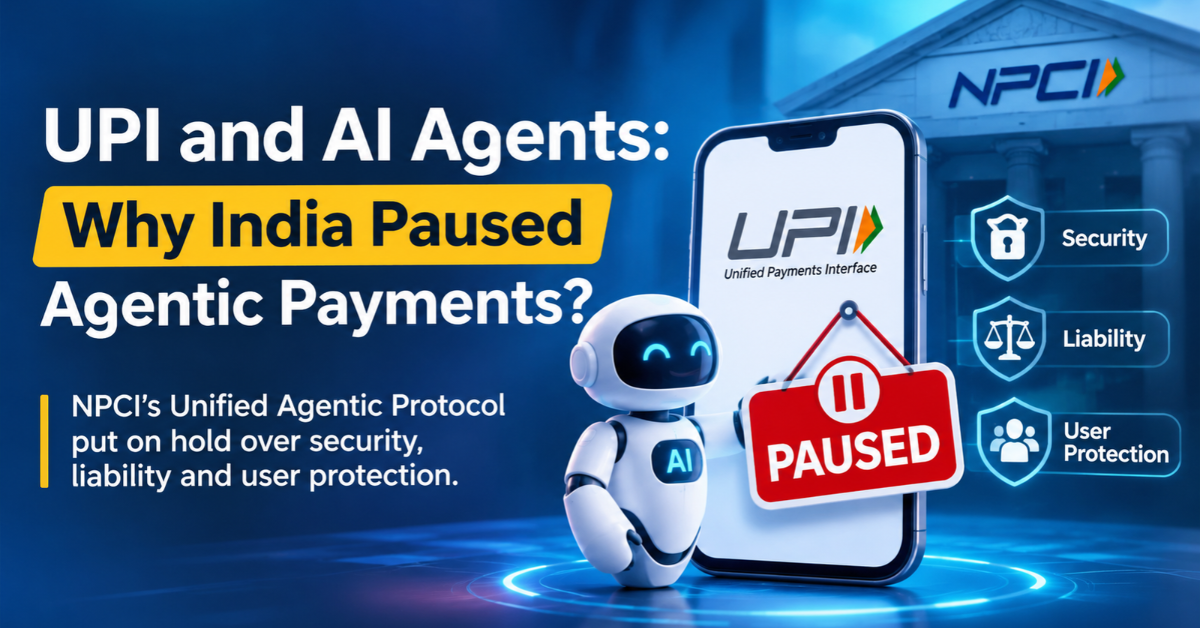
India’s digital payments ecosystem is entering a new phase where artificial intelligence (AI) could move beyond assisting users and start making payments on their behalf.
The National Payments Corporation of India (NPCI) has been working on a proposed Unified Agentic Protocol (UAP) that could allow authorised AI agents to conduct UPI transactions within predefined limits.
However, the proposed rollout was temporarily put on hold in September 2026 as concerns around user protection, liability, security and governance needed further consideration.
So, what exactly are agentic payments, why are they attracting attention, and why does India need additional safeguards before allowing AI systems to transact independently?
What Are Agentic Payments?
Traditional digital payments generally require the user to actively initiate or approve a transaction.
Agentic payments introduce a different model.
An AI agent could potentially receive an instruction such as:
“Buy my regular groceries within my monthly budget.”
Instead of asking the user to approve every individual purchase, the agent could search for suitable options, follow predefined rules and complete an authorised payment.
Early use cases are expected to focus on small and repetitive transactions, such as everyday purchases and recurring payments. More advanced applications could eventually involve transactions triggered by specific conditions, such as a price reaching a predetermined level.
What Is NPCI’s Unified Agentic Protocol?
The proposed Unified Agentic Protocol is intended to create a common infrastructure for AI agents operating within the UPI ecosystem.

The objective is not simply to give AI unrestricted access to bank accounts.
Instead, the proposed framework is expected to address questions such as:
- Is the AI agent genuine?
- Has the user authorised it?
- What is the agent allowed to purchase?
- What is its spending limit?
- Can its actions be audited?
- Who is responsible if something goes wrong?
Reports indicate that NPCI has been considering mechanisms for identifying, registering and authorising AI agents before they can transact through UPI.
Why Was the Agentic UPI Rollout Put on Hold?
The biggest issue is simple: AI can make decisions, but financial transactions require clear accountability.
The proposed launch was reportedly put on hold while concerns around regulatory approval, user protection, liability and governance were addressed.
This is important because existing payment systems were largely designed around a human user initiating or authorising transactions.
With agentic payments, another layer enters the process:
User → AI Agent → Merchant → Payment System → Bank
If the AI misunderstands the user’s instruction or exceeds its authority, determining responsibility becomes much more complicated.
1. Who Is Responsible for an Unauthorised Payment?
This could become one of the biggest challenges for agentic payments.
Imagine a user gives an AI agent permission to spend up to a certain amount every week. The agent then makes a transaction that the user did not intend.
Who should bear responsibility?
- The user?
- The AI developer?
- The payment service provider?
- The bank?
- The merchant?
- Another technology provider?
Clear liability rules will be essential before autonomous payments can operate at large scale. Reuters reported that liability for incorrect or unauthorised transactions remains an area requiring attention.
2. AI Intent Is Different From Human Intent
A conventional UPI transaction usually has a relatively clear chain of action.
The user selects a merchant, enters an amount and authorises payment.
An AI agent could instead interpret a broader instruction and decide how to achieve the user’s objective.
That creates a new question:
If an AI correctly follows an instruction but makes a decision the user dislikes, should that transaction be considered authorised?
This distinction between intent, authorisation and settlement is becoming increasingly important in discussions around agentic payments. NPCI officials have emphasised the need to preserve these distinctions as AI enters payment systems.
3. Security Risks Could Increase
Giving an AI agent access to payment functionality creates another potential attack surface.
An agent may interact with:
- Payment systems
- Merchant platforms
- APIs
- User accounts
- Product information
- Personal data
If an agent is manipulated, compromised or incorrectly configured, the consequences could involve financial transactions rather than simply incorrect information.
That is why agent identity, permission controls, audit trails and transaction limits are expected to become important components of India’s proposed framework.
4. India Needs “Know Your Agent”
Financial institutions already operate under extensive identity and verification requirements for customers.
Agentic payments introduce a new question:
Who is the AI agent acting on behalf of the customer?
NPCI’s reported plans include an agent registry intended to verify and monitor AI agents participating in transactions.
This could become an important part of the future payment ecosystem, particularly if different banks, fintech companies, merchants and AI platforms need to interact with the same agents.
5. Why India Is Taking a Cautious Approach
India has already demonstrated that digital payment infrastructure can scale to enormous volumes.
But autonomous payments are different from conventional digital payments.
The challenge is no longer only:
“Can the payment be completed securely?”
It becomes:
“Can the system prove that the AI had the right authority to make that payment?”
That distinction explains why regulators and payment infrastructure providers may prefer to establish governance and accountability mechanisms before allowing agentic payments to scale.
What Could Agentic UPI Look Like in the Future?
If the necessary safeguards are established, AI-powered payments could eventually become part of everyday digital commerce.
Potential examples include:
Automated Grocery Purchases
An AI assistant could monitor a user’s predefined grocery list and purchase items within an approved budget.
Subscription Management
An agent could identify upcoming recurring payments and handle them according to rules established by the user.
Price-Based Purchases
An AI agent could potentially purchase an item when its price falls below a user-defined threshold.
Bill Payments
Users could authorise an agent to manage certain recurring bills within predefined limits.
These examples represent potential future applications rather than a guarantee that every use case will be supported under India’s final framework.
What Could This Mean for Fintech Companies?
The arrival of agentic payments could create a major shift for the fintech industry.
Fintech companies may need to rethink:
- Customer authentication
- Consent management
- Transaction monitoring
- Fraud detection
- API security
- Agent verification
- Dispute resolution
- Liability frameworks
- Audit systems
The opportunity is significant, but fintech companies will need to balance automation with customer control.
UPI’s Next Evolution May Be About Trust
UPI transformed digital payments by making transactions fast, interoperable and easy for consumers.
The next evolution could involve allowing software to act on behalf of consumers.
But automation cannot come at the expense of trust.
For agentic payments to succeed, users need to know:
What has the AI been authorised to do?
How much can it spend?
When can it act?
Can the user stop it?
Who is responsible if something goes wrong?
These questions are as important as the underlying technology.
Conclusion
India’s decision to temporarily pause the proposed Unified Agentic Protocol highlights an important reality: building AI-powered payments is not only a technology challenge.
It is also a security, regulatory, consumer-protection and accountability challenge.
The idea of an AI agent making routine UPI payments on behalf of users could eventually make digital commerce more convenient. But before that happens at scale, India needs clear rules around agent identity, user consent, spending limits, security and liability.
The pause should therefore not necessarily be viewed as a setback for innovation.
Instead, it could be an opportunity to build a stronger foundation for safe and accountable agentic payments in India.
As AI becomes increasingly capable of acting on behalf of consumers, the future of fintech may depend not only on what AI can do—but on what AI is authorised to do.
Frequently Asked Questions
What are agentic payments?
Agentic payments are transactions where an authorised AI agent can make payments on behalf of a user according to predefined instructions, permissions or limits.
What is the Unified Agentic Protocol?
The Unified Agentic Protocol is a proposed NPCI framework intended to help identify, authorise and govern AI agents operating within the UPI ecosystem.
Why was India’s agentic UPI rollout paused?
The proposed rollout was temporarily put on hold while concerns involving regulatory approval, user protection, liability and governance were addressed.
Will AI agents be able to make UPI payments automatically?
That is the intended direction of agentic payment technology, but the exact capabilities and safeguards will depend on the final framework and regulatory approvals.
Are agentic payments available for everyone today?
The proposed NPCI framework is still subject to development and regulatory considerations. The final implementation, permissions and use cases may differ from early proposals.